Practical AI workflows judged by the ecommerce work they are meant to improve.
AI is judged here by the ecommerce work it is meant to improve, not by the demo. The desk covers research with AI tools, recommendation layers that change merchandising rules, the tracking of referral traffic from assistants, and where a person still has to own the question and the decision.
Every article is tested against a real operating problem, and the ones that recommend a workflow say what it costs, what it replaces and what it cannot do.
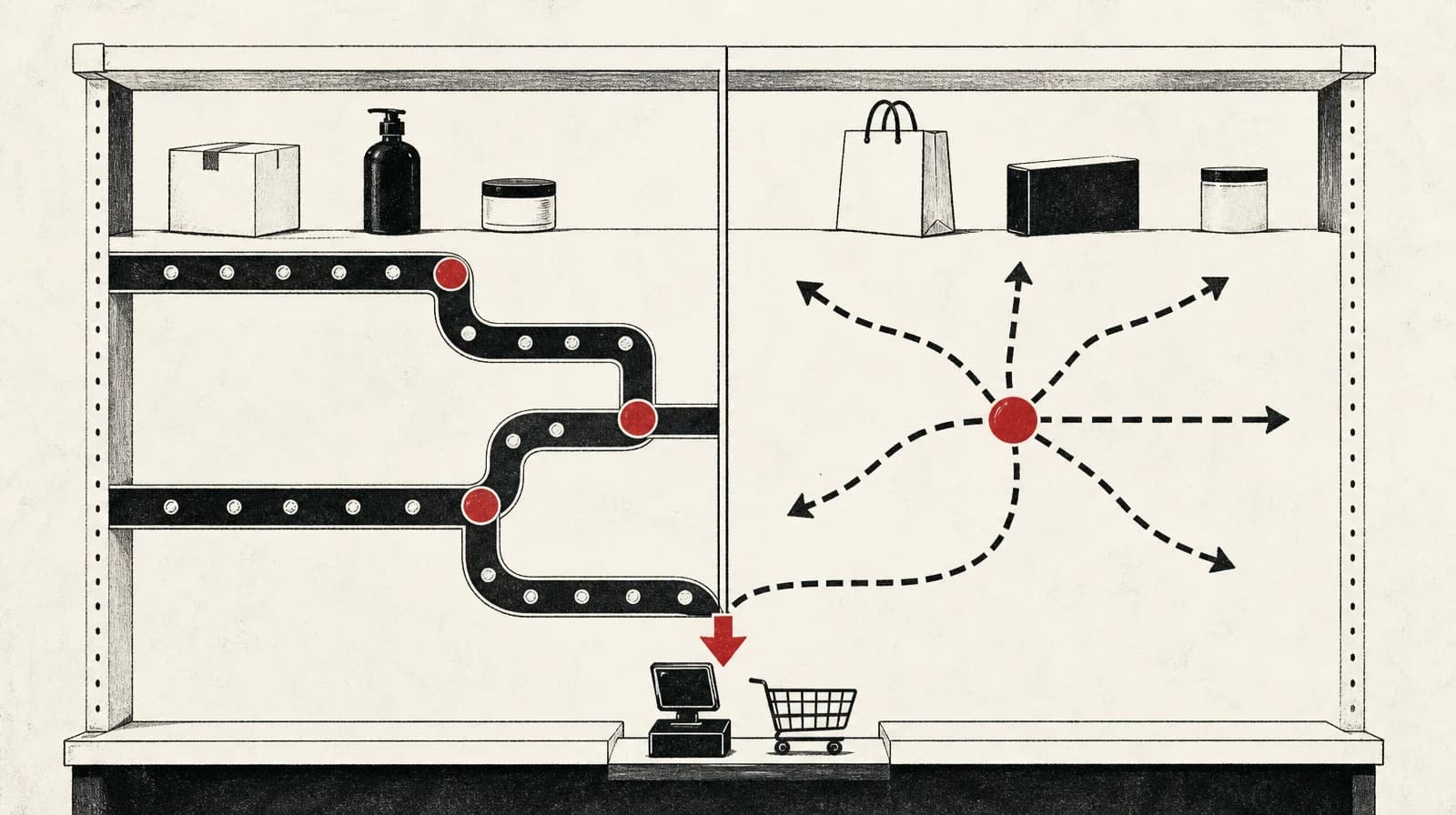
A store needs more than a definition of AI agents. Use the workflow test and a job-based taxonomy to assess support, catalogue and fulfilment tools, then separate those tools from agents shopping on a customer's behalf.
Before you decide whether to build a proprietary shopping agent or plug into ChatGPT and Google's protocols, you need to know what the agent can actually read on your product pages, because most of it is currently invisible.
Visible AI referral traffic still sits around 0.2% of sessions on the broadest public benchmark, and the undercount is wider than the channel. Here is a proportionate tracking ladder for D2C operators.
AI can widen retrieval, organise evidence and expose unanswered questions. An experienced operator still owns the question, the sources and the decision.