Key takeaways
An AI agent chooses its next step; a workflow follows predefined paths.
Evaluate the job and the data it needs before buying.
In ecommerce, separate tools you operate for support, catalogue or fulfilment from agents shopping on a customer's behalf.
A protocol announcement does not establish your store's current checkout eligibility.
When a supplier pitches you an "AI agent", the label alone tells you little. Maybe it's a customer service tool, maybe it's a merchandising add-on for Shopify, maybe it's an ops product that promises to fix fulfilment exceptions on its own. Before you sign anything or reallocate a team's time to "working with the agent", you need an answer to one question. Does this thing decide what to do next, or does it follow a script someone else wrote and call the script agentic?
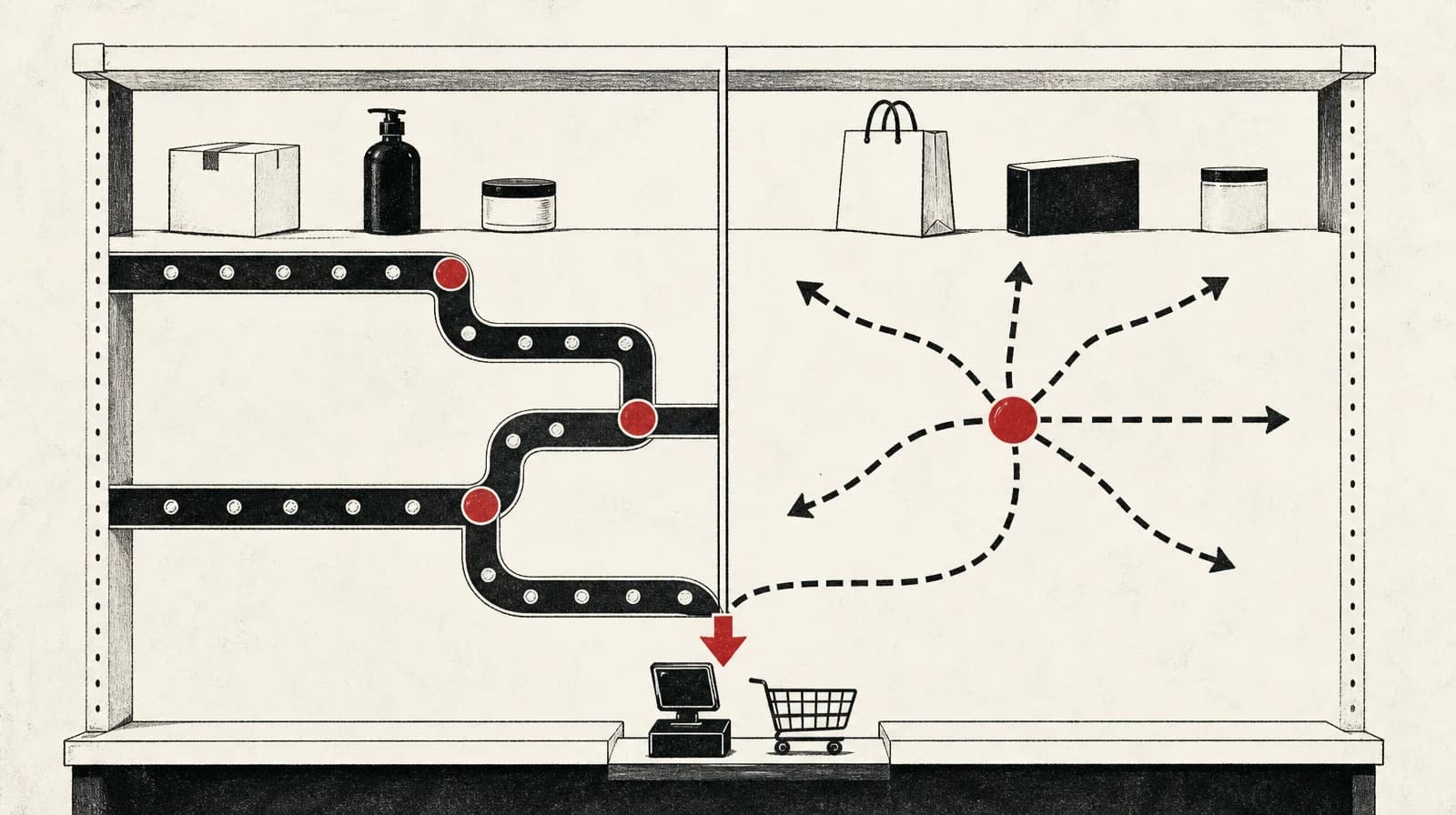
That question has a real answer, and it comes from an unusually plain source. Anthropic's engineering team draws the line between a workflow, where an LLM and some tools are wired through predefined code paths, and an agent, where the model directs its own process and tool use. Both count as agentic systems in their framing. The difference is who holds the steering wheel. A workflow's branches were decided by an engineer in advance. An agent decides, at runtime, what to do with the context in front of it.
The commercial stakes here matter as much as the architecture does. A workflow gives you predefined paths to inspect, even though an LLM's output within each step can vary. An agent trades that predictability for the ability to handle situations nobody scripted, at the cost of latency, spend, and a harder debugging problem when it does something you didn't expect. Anthropic advises teams to start with the simplest solution that works. That may mean using no agentic system at all. Increase complexity when the task warrants it. That is a primary engineering source telling paying customers not to buy the complicated version by default. That's worth remembering the next time a vendor's default answer is yes.
Why the incumbent explainers don't answer your question
IBM and Google Cloud explain the architecture. A store operator also needs to connect that architecture to a job worth paying for. IBM does distinguish agents from chatbots properly: a chatbot is a modality, agency is a technological framework, and a non-agentic chatbot lacks tools, memory or reasoning, can't plan ahead, and needs continuous user input to do anything. That's a fair contrast, and the most useful thing IBM's page does for an operator. What it doesn't do is map any of it to a store's actual jobs. It moves instead into architecture paradigms like ReAct loops and upfront planning, which is content for the person building the agent, not the person deciding whether to buy one.
Google Cloud's two explainers add two useful cuts. One splits agents by how a user meets them: interactive "surface" agents that respond to a query, versus autonomous background agents that work behind the scenes on inventory or data. The same page adds a cost caveat operators should hold onto: sophisticated agents can be computationally expensive, and that expense can be unsuitable for smaller organisations with limited budgets. Google Cloud's companion page on agentic AI cleans up a term people conflate: an agent is a single building block focused on one task, while agentic AI coordinates multiple agents across a workflow. Useful distinctions, still generic to any business, not a store.
Even the taxonomists admit the taxonomy is unsettled. Google Cloud states outright that there are different definitions of agent types and categories. None of it tells a store operator what to buy. That gap is real, and a job-based split does more for you here than another abstract taxonomy.
The buyer test: agent, or agent-washed automation
Before any taxonomy, run the purchase through a screen. Gartner predicted in June 2025 that over 40% of agentic AI projects will be cancelled by the end of 2027, citing escalating costs, unclear business value and inadequate risk controls. In the same June 2025 announcement, Gartner described vendors rebranding existing assistants, RPA tools and chatbots as agentic without adding substantial capability, a practice it calls agent washing, and estimated that of the thousands of vendors claiming agentic AI, only around 130 were real. Digital Applied's review of the figure's reuse found that a Forbes piece published in July 2026 revisits that year-old warning rather than reporting new findings, and that much of the mid-2026 coverage drops the original date when it recirculates the number. Keep the June 2025 date attached to that forecast; it is not a measurement of cancellations in 2026.
Gartner's June 2025 assessment was that most agentic propositions lacked significant value or ROI and that many proposed use cases did not require an agentic implementation. That gives you a useful screening question. Ask the vendor what decision the system makes that a rules-based workflow could not. If the honest answer is "it follows the same steps we always followed, just wrapped in a chat interface", you're buying a workflow with an agent's price tag.
Two different things are both called "agents" in a store
Once a tool passes the buyer test, the next split matters more than any vendor category list: is this an agent you operate, or an agent that arrives as your customer?
Agents you operate
Three jobs currently have working agent products behind them, each with a different precondition for whether the agent is any good.
Support
Support gives you a measurable job to test: how many tickets can the tool resolve without a person taking over? Superframeworks' June 2026 review reports a 38% resolution rate in a 500-ticket small-business test and a 42% to 50% cluster in Intercom's published Fin case studies. Those are figures collected by the reviewer from different settings, not a controlled comparison or a forecast for your store. Superframeworks suggests a broad 40% to 70% planning range, with ticket mix and knowledge-base quality driving much of the variation. Use your own ticket sample to test that assumption before budgeting around it. Functionally, a support agent like this combines retrieval over your help centre with something closer to a workflow underneath: predefined "procedures" that execute refunds, look up accounts or call an API, then hand off what it can't finish. That's Anthropic's workflow-inside-an-agent pattern in commercial form.
Merchandising and catalogue
Shopify's Spring '26 developer edition describes the Universal Commerce Protocol (UCP) and its Catalog API as the discovery layer that turns a merchant's product data into structured, queryable information across AI surfaces. Richer metadata, including size, colour and delivery estimates, gives an agent more context to act on. An agent can only merchandise what it can parse, so check what your product feed exposes before buying a tool to act on it.
Fulfilment and ops
SAP's own account of its Order Reliability Agent describes it as able to proactively resolve fulfilment issues before they reach the customer. That's a vendor describing its own product, not independent verification, but the underlying logic holds regardless of who sells it: an agent wired into order management and fulfilment systems is only as good as the inventory feed underneath it. If the stock feed is stale, an ops agent may act on inventory that is no longer available and create order errors. Test how it handles that mismatch before allowing it to change an order.
Agents that arrive as your customer
OpenAI's September 2025 Instant Checkout launch illustrates the division of responsibilities. It used the Agentic Commerce Protocol (ACP), developed with Stripe, and initially let US users buy from US Etsy sellers. Shopify merchants were listed as coming soon at that launch. In Stripe's September 2025 description, ChatGPT handled the buyer's side of the transaction; the merchant still accepted or declined the order, charged the payment method, calculated and remitted tax, and handled fulfilment and returns. That dated example shows why a new shopping interface does not remove the merchant's operational work. It does not establish what checkout options are available to your store today.
For an integration starting point, OpenAI's current commerce guide begins with a structured product feed and says feed onboarding is available to approved partners. Its purpose is to give ChatGPT accurate catalogue information. Check the current integration requirements and the actual payment handoff for your market before treating discovery traffic as a working sales channel.
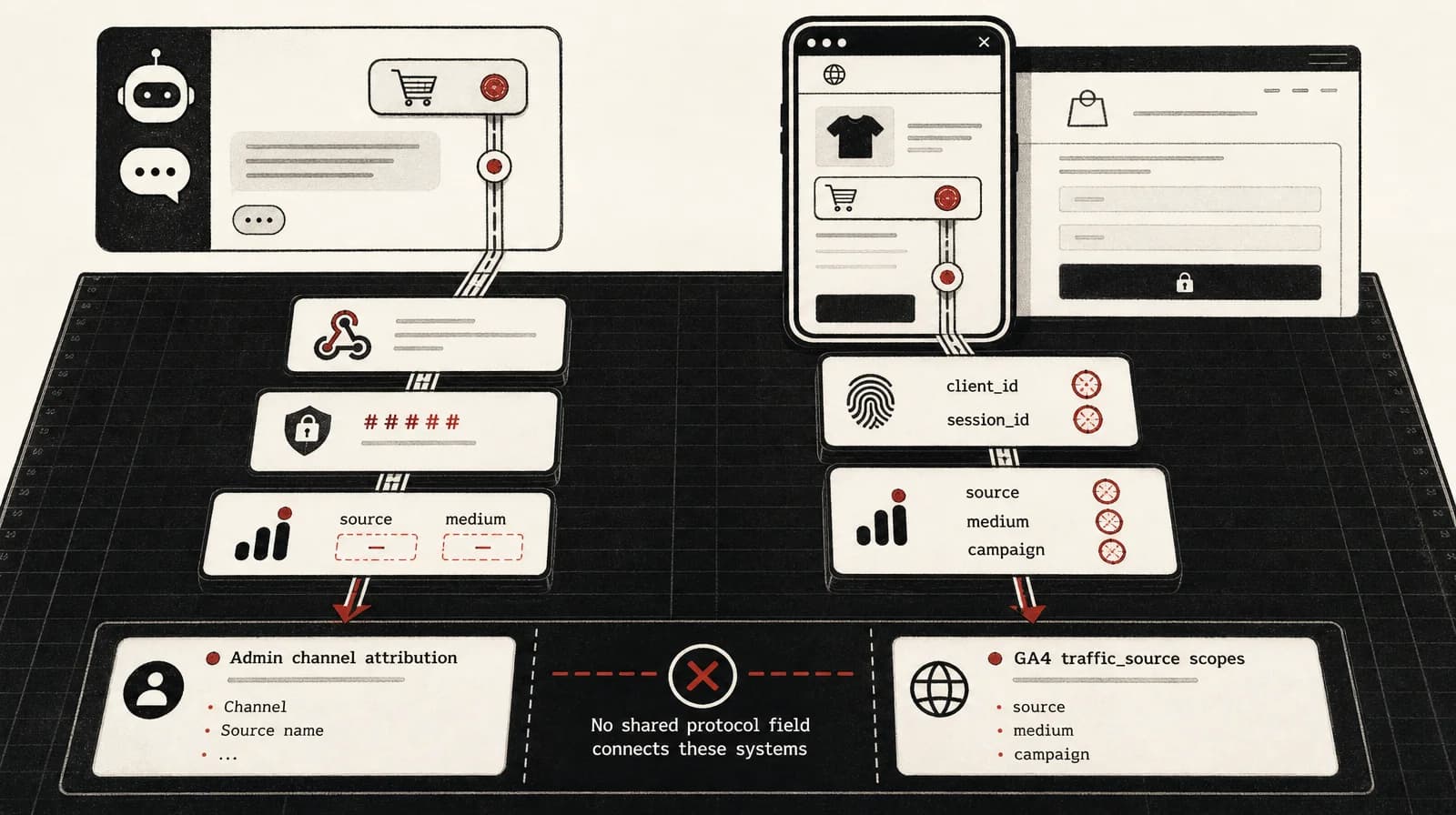
Shopify's Universal Commerce Protocol runs alongside ACP, co-developed with Google and backed by Amazon, Meta, Microsoft, Salesforce, Stripe, Etsy, Target and Wayfair, and implemented through Shopify's own developer documentation as a set of tools an agent calls to negotiate access, discover products, build a cart, hand off to the merchant for payment, and monitor the resulting order through webhooks. Agents register a profile so Shopify can rate-limit and tier their access, with higher trust levels unlocking more, including direct checkout completion. For a build decision, compare the documented functions you need from ACP and UCP. Confirm which your platform supports before committing engineering time, and test where the buyer leaves the agent interface for payment.
What decides whether any of this works
Thread the three operated categories and the inbound-agent track together and one constraint repeats: every agent's usefulness is bounded by what it can read or connect to. A support agent is bounded by knowledge-base quality and ticket mix. A merchandising or discovery agent is bounded by how structured your product data is. A fulfilment agent is bounded by whether inventory visibility is actually real-time. That's a data and systems problem, and it sits with you, whatever model sits underneath the agent.
This is also where the taxonomy stops being enough on its own. Knowing which category a tool belongs to tells you what job it's suited for. It doesn't tell you whether your product pages, your help centre, or your inventory feed are in a state that agent can actually use. That's the harder, more specific question, and it's covered separately: what an agent can actually read on your product pages, and who owns the workflow once it's live.
What's unresolved
The September 2025 launch sources describe US access at that time. They do not establish current UK eligibility, supported merchants or cart limits. For a UK store, check the current onboarding requirements with the platform and test a complete order, including payment, tax, cancellation and returns, before planning a launch.
The support figures above come from a secondary review of different deployments. They are useful questions for a trial, not a measured resolution rate for your D2C store. The sources used here also do not establish how much agentic-checkout revenue a comparable independent brand should expect. Start with a small, measurable job: use a representative ticket sample for support, validate the fields a discovery agent receives, or test a fulfilment exception against your live inventory feed. Record the failures and the human work needed to finish each task. That gives you something concrete to compare with the vendor's promise.
Sources
- What Are AI Agents? | IBM ibm.com Defines AI agent as a system capable of autonomously performing tasks on behalf of a user or system
- Building effective agents | Anthropic Engineering anthropic.com Corrected wording: Anthropic recommends finding the simplest solution possible and only increasing complexity when needed; it is the simplest-solution principle, not added complexity, that 'might mean not building agentic systems at all'
- What are AI agents? Definition, examples, and types | Google Cloud cloud.google.com States agent taxonomies are unsettled; multiple competing definitions exist
- What is agentic AI? Definition and differentiators | Google Cloud cloud.google.com Distinguishes an agent (single-task building block) from agentic AI (coordinating multiple agents across a workflow)
- Gartner announcement distributed through PRwire, 25 June 2025: agentic AI project forecast prwire.com.au Original Gartner-issued announcement, identified on PRwire as posted by Gartner on 25 June 2025; this is a distributed press release, not independent outcome research.
- Why Agentic AI Projects Get Canceled (and How to Ship) — Digital Applied digitalapplied.com Supports the dating claim: a Forbes analysis published July 7, 2026 revisits Gartner's year-old warning rather than reporting a new finding
- Etsy pops 16% as OpenAI announces ChatGPT Instant Checkout for the shopping site — CNBC cnbc.com Reports the September 29, 2025 launch of Instant Checkout in ChatGPT; initially supports single-item purchases from US Etsy sellers, available to US ChatGPT Plus, Pro and Free users
- Stripe and OpenAI: Instant Checkout stripe.com Stripe announcement dated 29 September 2025. Describes US ChatGPT access to Etsy at launch and Shopify merchants as coming soon.
- Agentic commerce for every developer: The Spring '26 Edition | Shopify shopify.com Backer list verified on the current page: UCP is the standard Shopify co-developed with Google, with support from Amazon, Meta, Microsoft, Salesforce, Stripe, Etsy, Target and Wayfair — so 'backed by Stripe and Etsy among others' is supported, though Stripe also backs ACP
- Agentic commerce | Shopify developer documentation shopify.dev Details MCP tools implementing UCP: agent registration/trust tiers, product discovery, cart-to-checkout handoff, order monitoring via webhooks
- Agentic AI Is Reshaping Commerce: The Next Frontier of Discovery, Payments, and Trust - SAP News news.sap.com Vendor-authored (SAP) source: supports the named example of SAP's Order Reliability Agent proactively resolving fulfilment issues before they reach the customer, stated in conditional 'can' framing rather than as measured deployment
- Best AI Customer Support Tools | Superframeworks superframeworks.com Superframeworks review dated 12 June 2026, a secondary compilation rather than a controlled comparison or a D2C forecast.
- Agentic AI Project Cancellations: Gartner's 40% Prediction Revisited digitalapplied.com Notes that mid-2026 coverage of the Gartner 40% figure often drops the original 2025 publication date, presenting a year-old prediction as new
- OpenAI commerce: Get Started developers.openai.com Official integration guide says product-feed onboarding is currently available to approved partners.