Key takeaways
Yes, for channel decisions: report Shopify, Amazon and wholesale contribution margin separately after only costs that vary with each channel, leave common fixed overhead unallocated, and split shared Meta spend only under rules you stress-test.
Move spend only if the channel ranking still holds.
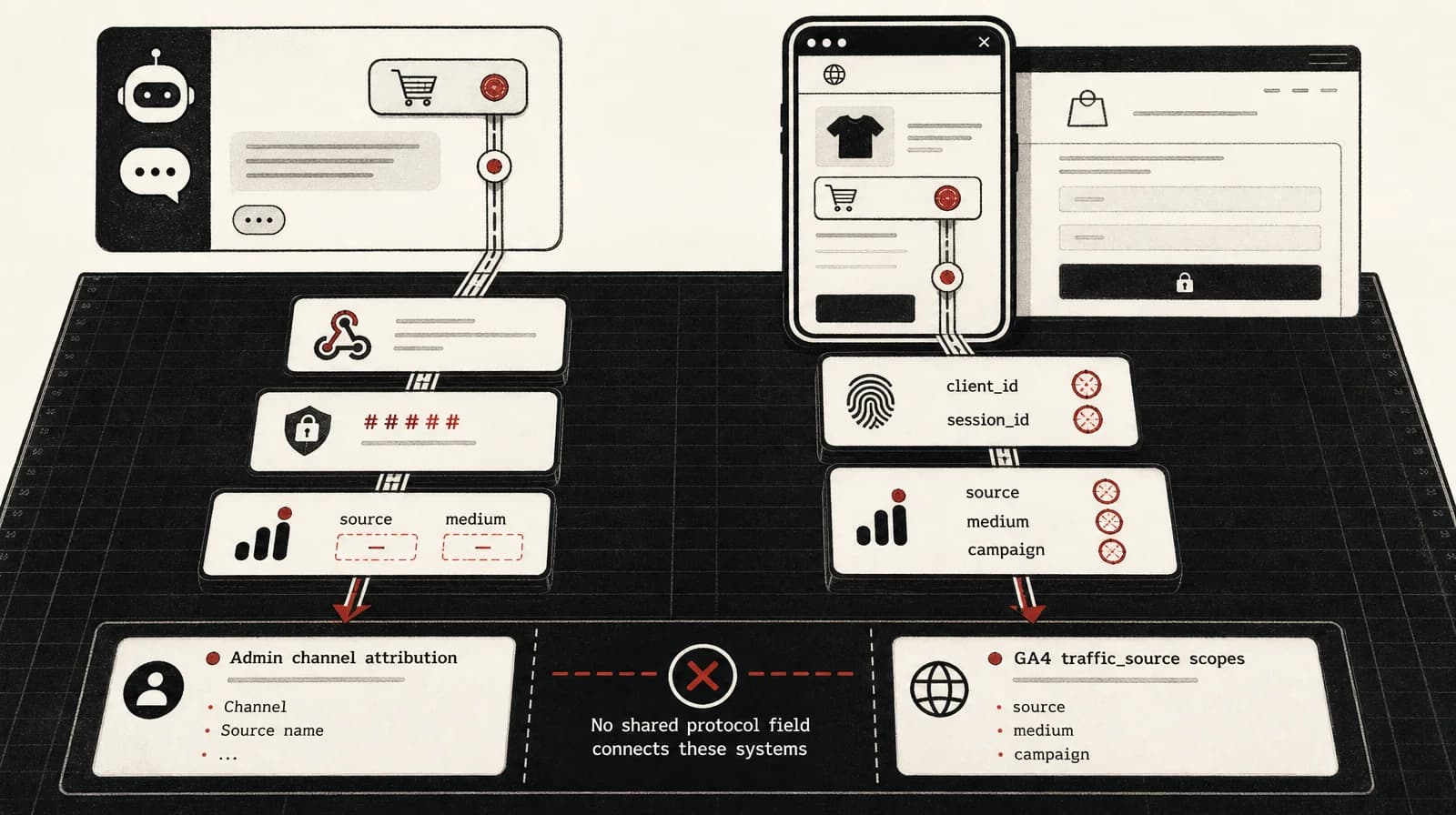
Meta cannot confirm Amazon purchases, so an attributed split is an assumption.
Report the channel, not a fake net profit
A seller running Shopify, Amazon and wholesale can report contribution margin separately without pretending each channel has its own net profit. For channel decisions, start with costs that vary with that channel's sales. Then subtract fixed costs you can trace to the channel. Leave common fixed overhead off both lines. A shared Meta budget is not overhead of that kind. Split it under rules you write down, and do not move spend when the channel ranking flips.
The segment-reporting references used here are general managerial accounting, not ecommerce manuals. Using them on Shopify, Amazon and wholesale is a method, not a conclusion those references draw.
A blended margin hides the next decision
One company contribution margin can look healthy while Amazon is thin after its own fees, and while wholesale is carrying a rep you would still pay if Amazon disappeared. The next decision is usually concrete. Where does next month's Meta spend go? Does Amazon still leave enough after the costs that move with its orders? Is the wholesale rep a cost of that channel, or a company cost?
Shared costs distort that decision in two different ways.
Common fixed overhead, such as rent, a finance salary or software used by the whole company, does not belong to a channel. In the segmented income statement set out by the University of Cincinnati Press accounting text, segment margin is contribution margin minus traceable fixed costs. Common fixed costs are not used to calculate that margin. They are subtracted from the company total of segment margins to reach net operating income, because they are not traceable and would not be eliminated if the segment were eliminated.
Shared demand spend is not that kind of cost. A Meta budget can rise, fall or be pointed at a different landing page. It is discretionary. It can still be common to Shopify and Amazon, because one ad account can be associated with orders on both. Any split is an assumption until you state the rule.
What goes wrong when every cost is forced onto a channel?
Two habits cause most of the bad calls.
The first is spreading common overhead so that every channel covers its share. Accountingverse illustrates the mechanical result: allocate $8,000 of common fixed costs at 50% to each of two segments, and one segment reports a loss. The loss is produced by the split. It is not evidence that closing the segment would save the $8,000. Push rent and salaries onto Amazon because its margin is lower, and you can talk yourself into leaving a channel that was still contributing cash towards costs you will pay anyway.
The second habit sits on the ad invoice. If the only pixel you trust is on Shopify, the whole Meta bill lands on Shopify, and Amazon's contribution margin is shown with none of that demand spend. Amazon looks cleaner than a shared reading would allow. Shopify looks more expensive. If some of that activity produced Amazon orders, the ranking is a booking choice.
A third habit is judging a channel manager on costs they do not control. For that evaluation, Accountingverse limits the fixed costs to those the manager can control. A wholesale rep hired by the founder is not the same object as the media buyer's Meta invoice.
Keep three results, and keep two costs below the line
Use one monthly statement, in this order.
Channel contribution margin is net revenue minus costs that rise with that channel's sales. Product cost, outbound freight, payment fees, and marketplace fees that move with Amazon orders belong here. Channel-only ads, such as Sponsored Products, belong to Amazon. They are not part of the shared Meta split. If that Amazon media cost is a fixed retainer rather than spend that moves with sales, put it in traceable fixed costs instead.
Channel segment margin is contribution margin minus fixed costs traceable to the channel, such as an Amazon-only agency retainer or a wholesale rep. These are costs you would expect to drop if you closed the channel, subject to notice periods and contracts.
Below both of those, on their own lines, sit shared demand spend and common fixed overhead. Do not fold them into segment margin and then call the result the channel's profit.
Accountingverse draws a finer line when a person is being judged: contribution margin minus the direct fixed costs that manager controls, then segment margin after other direct fixed costs. Use that cut for the person. Use the simpler segment margin for the question of whether the channel covers its own traceable costs.
Watch the nesting. A fixed cost of one segment may be a common fixed cost of another segment. Applied here, a fulfilment contract can be traceable to direct-to-consumer as a group and still be common across Shopify and Amazon orders you ship yourself. Split that group before you treat the contract as one channel's cost.
Label dollars and ratios separately. A 20% contribution margin ratio on a small channel is not the same decision as a large dollar contribution from a bigger one.
How should a shared Meta budget be split?
Classify the line before you pick a percentage.
If the cost varies with one channel's sales, it is already inside that channel's contribution margin. Do not split it again. If it is fixed and would go away with the channel, it is traceable, and it belongs in segment margin. If it is one Meta budget that can be tied to orders in more than one channel, it is shared demand spend. Split it only in a sensitivity view. If it would remain after you closed any one channel, it is common overhead. Leave it unallocated when you are choosing a channel.
For the Meta budget, run the same month under more than one rule.
Revenue share splits the invoice by the net revenue of the channels the ads can actually reach. If the links land on Shopify and Amazon only, wholesale's share is zero under this rule. Equal revenue means an equal split. The rule is easy to audit. It is not evidence that each channel caused an equal share of the orders.
Attributed share uses credited purchases. Read it with the measurement limits in view. The points in this section come from trade and vendor write-ups, not from Amazon help pages checked for this article. Confirm the product behaviour in your own account before you book a number from it.
PPC Land describes Amazon Attribution as a free measurement product from Amazon Ads that tells brands what happens on Amazon after a shopper clicks an ad bought somewhere else. The same explainer describes the gap: a brand running Meta ads to an Amazon page cannot see, from those platforms, whether the click became a detail page view, an add to cart or a purchase. Polar Analytics describes Attribution as tagging off-Amazon links and reporting detail page views, add to carts, purchases, new to brand and brand halo. It reports that qualification needs Brand Registry with brand representative status, or vendor or agency access. If you do not qualify, you do not have that purchase count.
The cost join is yours even when you do qualify. WisePPC's write-up makes the practical point that you paid Google or Meta, not Amazon, so Amazon Attribution has no cost, ACoS or ROAS. SellerStack's glossary records that Attribution credits the single most recent click within 14 days, a different window from a seller's 7-day Sponsored Products sales. It also records that a Google or Meta campaign run straight to a listing shows nothing in Amazon's standard ad reports. Those glossary points were not checked against Amazon Ads help documentation here, so confirm the window in the account. Polar's comparison table treats Meta's view of Amazon outcomes as inferred, not confirmed by Amazon. SalesDuo's write-up supports the point that the Meta pixel cannot track purchases directly inside Amazon. An attributed split therefore mixes counts that were not built to be added. Write it down as an assumption, with the date range, not as a receipt.
PPC Land reports that on 1 October 2025 Amazon changed branded search identification in Attribution. If a series crosses that date, check Amazon's note before you treat the shares as continuous. The mechanics of that change are not described here.
An incrementality-informed share is the third rule. It is a principle, not a formula taken from a Meta-to-Amazon study. An Amazon Ads paper dated 11 August 2025, posted on arXiv, says credit should reflect causal contribution, and that attribution shares need a reliable measure of incrementality. One method it describes is a holdout: one group of shoppers can see the ads, another cannot. Peer-review status is not established here. The paper covers credit across Amazon Ads touchpoints for Amazon conversions. It is not a method for splitting a Meta invoice between Shopify and Amazon. If you want a causal share, you need a test that can show incremental orders. Renaming a last-click export does not do that.
If your wholesale orders have no click to tag, that is an operating assumption, not a researched finding about every wholesale account. Show a zero Meta share in that case, and say so. It is not a measurement that brand activity did nothing for retailer sell-through. If you believe it did, add a second view with an explicit brand-support percentage and name who chose it.
One invented month, three rules, one ranking that flips
Every figure below is invented, in US dollars, for one month. It is not a benchmark, a fee card or a store result. Marketplace and fulfilment fees are a single invented lump, not Amazon's published rates.
Net revenue is $60,000 on Shopify, $60,000 on Amazon sold by you as a third party, and $40,000 wholesale. If Amazon buys the stock from you, put that relationship in wholesale, not in the third-party Amazon column. The two relationships do not share a fee structure, and this example does not model the buying relationship.
Channel-variable costs, all invented:
Shopify: product cost $24,000, outbound shipping $6,000, payment fees $1,800. Total $31,800. Contribution margin $28,200, which is 47% of net revenue.
Amazon: product cost $24,000, marketplace and fulfilment fees $18,000, Sponsored Products $6,000, treated here as varying with Amazon sales. Total $48,000. Contribution margin $12,000, which is 20% of net revenue.
Wholesale: product cost $28,000, freight to the retailer $4,000. Total $32,000. Contribution margin $8,000, which is 20% of net revenue.
Traceable fixed costs: Shopify tools $1,200, an Amazon-only agency retainer $3,000, a wholesale rep $4,000.
Segment margin, before shared Meta and before common overhead: Shopify $27,000, Amazon $9,000, wholesale $4,000. Amazon and wholesale have the same 20% contribution margin ratio in this month, and different segment margins. The ratio alone would have hidden that.
The shared Meta invoice is $18,000. Assumption for the base case: links can land on Shopify or on a tagged Amazon page, and there is no wholesale landing page. Wholesale's default share is zero.
Rule A is revenue share of Shopify and Amazon. Revenue is equal, so each is charged $9,000. Residues: Shopify $18,000, Amazon $0, wholesale $4,000. Order: Shopify, wholesale, Amazon.
Rule B is an attributed share treated as an assumption, not as a platform export: 80% Shopify and 20% Amazon, so $14,400 and $3,600. Residues: Shopify $12,600, Amazon $5,400, wholesale $4,000. Order: Shopify, Amazon, wholesale. Amazon now ranks above wholesale. The channels' own costs did not change. The rule did.
Rule C is an incrementality-informed share, also assumed, not a test result and not a published lift: 55% Shopify and 45% Amazon, so $9,900 and $8,100. Residues: Shopify $17,100, Amazon $900, wholesale $4,000. Order: Shopify, wholesale, Amazon. The Rule B flip is gone.
Shopify stays first under all three rules. In this invented set, that part of the ranking is stable. You do not need a Meta allocation to see the unsplit lines. Amazon's variable-cost load is heavier than Shopify's. Its segment margin is $9,000 against wholesale's $4,000 only after that load and after the traceable fixed costs chosen above.
Calculate the fully loaded view once, then do not manage by it. Common overhead is $24,000 and would remain if any one channel closed. Total revenue is $160,000, so a revenue spread assigns 37.5% to Shopify, 37.5% to Amazon and 25% to wholesale: $9,000, $9,000 and $6,000. Subtract those amounts from the Rule A residues and Amazon shows a $9,000 loss, wholesale a $2,000 loss. Closing Amazon would not save that $9,000. This is the same kind of artefact as the $8,000 illustration: an arbitrary common-cost split can create a reported loss.
A brand-support variant, also assumed: assign 15% of Meta, $2,700, to wholesale, and split the remaining $15,300 equally, $7,650 to Shopify and $7,650 to Amazon. Residues: Shopify $19,350, Amazon $1,350, wholesale $1,300. Amazon leads wholesale by $50. A percentage typed into a notes column is enough to reorder them.
What decision can this report support?
Report the three channels separately. Contribution margin and segment margin are worth separating because the cost structures differ, and because neither line needs the Meta split. Use them to see whether a channel covers the costs that vary with its sales, and the fixed costs that would go with it.
Do not reallocate Meta, and do not rank Amazon against wholesale, from one shared-cost split. If two rules you are willing to defend reverse the rank, improve the measurement before you move money. That means tagged links where you are eligible to use Amazon Attribution, a cost join you can show, and a real incrementality test if you want a causal share. It does not mean another decimal place on counts that were not built together.
Keep common overhead on the company line. A fully loaded channel total is a stress test, as the invented $9,000 Amazon loss is a stress test. If someone is paid or reviewed on a channel number, restrict that number to costs they control.
Build last month's statement from your own revenue and invoices. Put at least two Meta rules side by side before the next budget meeting. If the ranking holds, the allocation is not what the decision turns on. If it flips, the next job is measurement, not a new channel target.
The measurement problem is picked up in How to judge campaigns when attribution fragments and How to read blended media efficiency without losing the plot.
- Build each channel contribution margin from net revenue minus costs that rise with sales on that channel.
- Subtract only fixed costs that would disappear if that channel closed. That residue is segment margin.
- Leave common overhead on one company line.
- Split shared Meta spend under at least two written rules, with wholesale at zero unless you state a brand-support percentage.
- Move budget only if the channel ranking survives the second rule.
Sources
- Segmented Income Reporting ucincinnatipress.pressbooks.pub Supports the contribution margin, then segment margin, then net operating income structure.
- Segment Margin and Segment Reporting accountingverse.com Contribution margin minus direct fixed costs controllable by managers equals contribution controllable by segment managers, also called short-run segment margin. Segment margin follows after direct fixed costs controlled by others.
- Variable Costing and Segment Reporting management.web.uniroma1.it Fragmentary snippet only. Supports that fixed costs of one segment may be a common fixed cost of another segment.
- Amazon Attribution ppc.land Trade publication, not Amazon's own documentation. Describes Amazon Attribution as a free measurement product from Amazon Ads that tells brands what happens on Amazon after a shopper clicks an ad bought somewhere else.
- Amazon Attribution: What It Tracks, What It Misses, and How to Read It polaranalytics.com Vendor write-up. Attribution tags off-Amazon links and reports detail page views, add to carts, purchases, new to brand and brand halo.
- Amazon Attribution and Attribution Windows, Explained sellerstack.ai Vendor glossary. Attribution credits the single most recent click within 14 days, so off-Amazon channels are measured on a different window than a seller's 7-day Sponsored Products sales.
- Amazon Attribution Reports wiseppc.com Vendor write-up. You paid Google or Meta, not Amazon, so Amazon Attribution has no cost, ACoS or ROAS. The operator has to join Meta spend to Amazon outcomes.
- Amazon Multi-Touch Attribution paper arxiv.org Amazon Ads paper on arXiv, dated 11 August 2025. Peer-review status is not established.
- Facebook & Meta Ads for Amazon (2026) salesduo.com Agency vendor page. Meta Pixel cannot track purchases directly inside Amazon.