Key takeaways
Judge Performance Max at campaign level.
Google says channel-level ROI can be misleading, so use the new report to find causes and experiments to decide spend.
GA4 AI sessions and Klaviyo delivery still do not measure incrementality or inbox placement.
Does the PMax channel report change how we judge the campaign?
You have to decide, this week, whether a Performance Max channel line, a GA4 AI Assistant session or a Klaviyo delivered count is allowed to move budget. Treat a diagnostic as an evaluation and you will cut a channel that was intercepting demand you already owned, or you will scale a campaign whose reported ROAS was borrowed from brand Search. The cost is cash and a board pack you cannot restate.
Google now publishes a channel performance report for Performance Max. The report has three sections: a performance summary, a Channels-to-Goals chart and a channel distribution table. Campaign-level summary metrics include actual ROAS and CPA, average target ROAS and CPA, interactions and conversions. Google's Ads blog on 7 January 2026 lists metrics for Search, YouTube, Discover, Gmail, the Display Network, Search partners and Maps in that table, with format-level breakdowns that include Shopping ads using product data on Search, and says the table data is downloadable.
That is more visibility than operators had. Extra columns do not license a channel-level campaign verdict.
Channel-level ROI can send budget to the wrong place
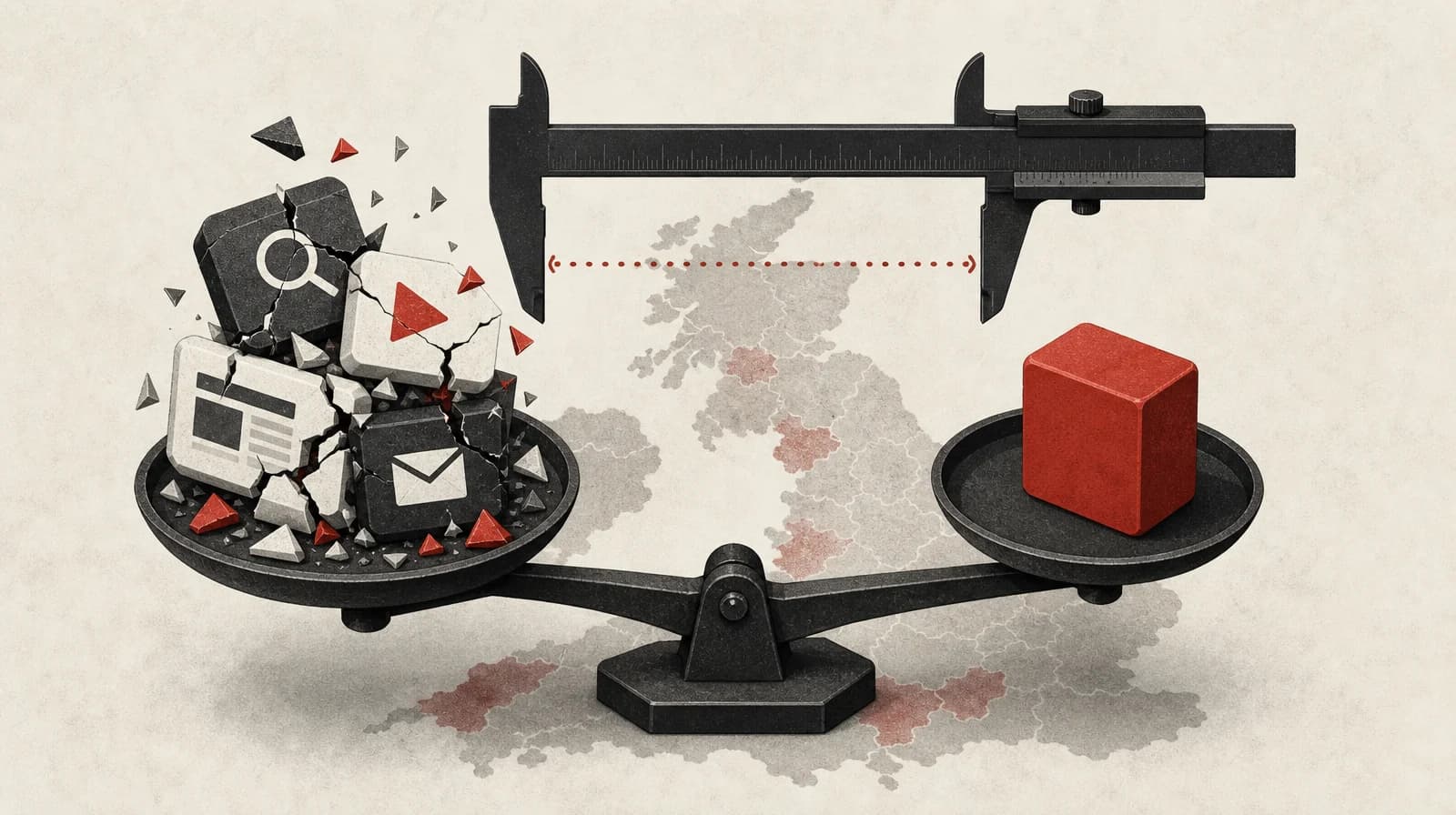
The commercial problem is a spend decision taken on a ratio the auction was not designed to protect. Google's troubleshooting page for the Performance Max channel performance report tells advertisers to focus on the campaign's overall ROI because channel-level ROI can be misleading. The mechanism it names is marginal ROI allocation: budget can go to a channel with lower average ROI if the next dollar returns more. Conversion delay also differs by channel, so a date range that still includes the delay period will make one channel look worse than another for reasons that have nothing to do with incrementality.
PMax still allocates budget automatically across channels. Advertisers cannot directly control that allocation. Google also names campaign cannibalisation between multiple PMax campaigns targeting similar areas as a troubleshooting cause. If you read channel ROAS as a vote on where to put the next pound, you are fighting an allocator that is not trying to maximise average channel ROI, and you may be looking at unfinished conversion windows.
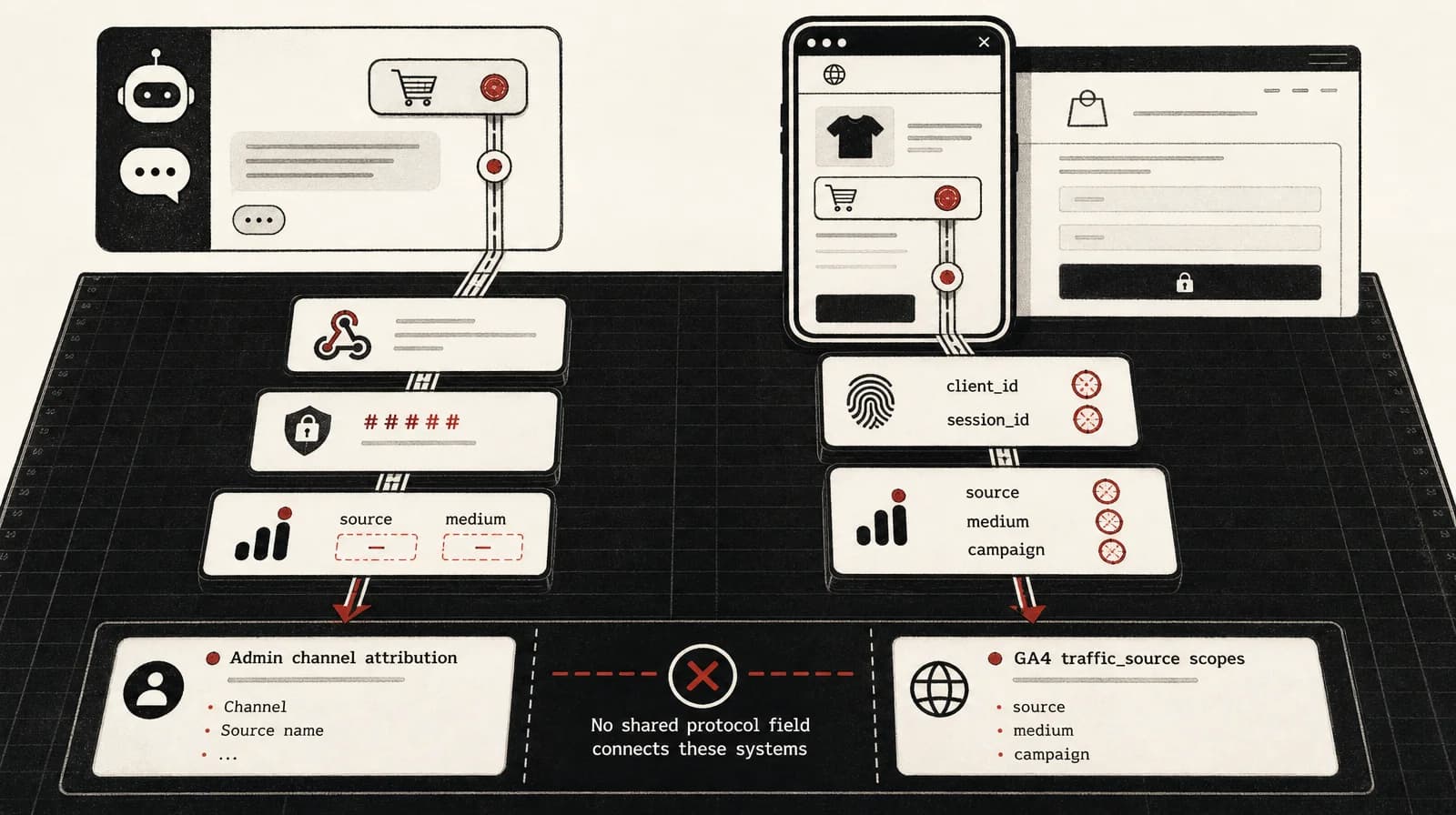
The same fragmentation now sits outside Google. Meta will still report its own conversions. GA4 will put some assistant traffic in a new default channel and leave other visits in Direct or Referral. Email will report delivered. None of those systems shares a definition of contribution profit (revenue after product cost, discounts, shipping, payment fees and expected returns), and none of them will deduct those costs unless you feed that economics in elsewhere. Should paid media optimise for ROAS or profit? remains the spend question. What actually counts as total marketing spend in a board-level MER report is the denominator question. Channel tables answer neither.
Last-click PMax ROAS still inflates the story
The usual fix is to stare harder at the new columns.
One version is to reallocate PMax budget toward the channels with the tidiest ROI in the distribution table. That is the move Google warns against. Eddie Cheng at Penang Media has seen teams cut a weak-looking Display or YouTube channel inside PMax and then watch total new-customer or top-line movement get worse, or stay flat while the strong channel re-credits the same demand. He treats channel-level ROAS as a local result and judges the cut on total effect across the account, not the tile that looked soft.
Another is to exclude brand terms from PMax, then read the campaign's last-click or Google-attributed ROAS as the result. ClickTrends' practical guide on brand Search cannibalisation in Performance Max is blunt about the stakeholder risk: accounts judging on last-click or Google-attributed data will see PMax ROAS drop when brand traffic is excluded, because brand conversions were inflating it. The exclusion can be the right operational move and still look like a failure in the number the team is used to defending.
A third version is to run a short incrementality test and act on whatever lift percentage appears. Improvado's 2026 marketing-lift overview, which you should treat as commonly cited vendor guidance rather than a primary study, says the read-out should be absolute incremental revenue, not relative lift. Amsive's geo-holdout design piece makes the sharper point: if the team would act at +10% but not at +5%, the test must distinguish those two results. A test that only detects a 15% effect answers neither question.
On the analytics side, teams build a custom GA4 channel rule for AI hostnames and leave it under Referral. Digital Applied's playbook on the AI Assistant channel notes that GA4 evaluates channel rules top-down, so a custom AI rule must sit above Referral or the traffic is miscategorised. Rule order, not regex, is the usual cause.
On email, delivered is treated as inbox. Klaviyo's own help centre says that is a different event.
What is this report allowed to decide?
The useful split is diagnostic against evaluative, not Google versus Meta versus AI.
A diagnostic report tells you where to look: a format with a potential issue, a channel whose conversion delay has not closed, a PMax campaign overlapping another PMax campaign, a spike in Direct that might be stripped app referrers. An evaluative result is one you would spend or cut against: campaign-level ROI against a written target, blended marketing efficiency ratio (MER, total revenue over total marketing spend) next to contribution profit, or an incrementality test whose minimum detectable effect matches the decision.
Google's two PMax pages pull in opposite directions if you read them as a single scorecard. The channel performance report exists so you can drill into channels and formats and surface potential issues. The troubleshooting page tells you not to use channel-level ROI as the campaign verdict. Use the drill-down to find causes. Keep the verdict at campaign level.
The same split applies to GA4's AI Assistant channel and to Klaviyo. The new channel is a forward-only reclassification of sessions Google already knew how to tag. Delivered is a server event. Neither is lift.
Write which report can move money
Start with a one-page measurement policy. Who owns the next spend change. Which report is allowed to trigger it. What would make the team stop. If that page does not exist, the new PMax columns will fill the gap by default.
Then the method, in the order operators actually hit it.
Performance Max: campaign first, channels as diagnostics
Read the campaign summary: actual ROAS or CPA against the average target, interactions and conversions. Use the Segment control when you need a cut. Google notes that multiple segments are available only in the download. Use diagnostics to drill into channels and formats. Do not treat a weaker average ROI on Display or YouTube as an instruction to claw budget back by hand. You cannot directly control that allocation anyway.
Exclude the conversion-delay window before you even read channel ROI as a curiosity. Then put the curiosity down and look at campaign-level ROI, contribution profit and MER. How to read blended media efficiency without losing the plot is the companion read when Meta and Google are both in the mix.
First-party exclusions and new-customer goals are a different job again, and they live in the PMax settings rather than in this report. Should you exclude existing customers from PMax, and where should the lists live? covers that split.
Branded Search overlap is an account test
You will not get an auditable overlap dataset from the sources here. Objective Platform's argument is that PMax and Search bid on the same inventory and keywords, so they sit on one shared response curve rather than two. Whether PMax adds or cannibalises then depends on how saturated existing Search coverage already is: headroom when Search is not yet saturated, mostly interception when it is. Treat that as a vendor argument, not a measured result.
ClickTrends' operational test is the practical method the dossier actually supports.
- Build a dedicated brand Search campaign first, so excluded PMax traffic has somewhere to land.
- Apply brand exclusions to one PMax campaign for two weeks.
- Monitor that PMax campaign and the brand Search campaign together.
- Compare total account brand conversion volume before and after. If total brand conversions stay flat or rise while PMax brand cost falls, the exclusion is doing the job.
Expect the PMax ROAS in last-click or Google-attributed reporting to look worse. That is the reporting trap, not proof that the exclusion failed. Eddie Cheng's read when Penang Media runs a brand-exclusion style test is that reported PMax ROAS often drops because branded conversions stop landing in the PMax column, even if total brand conversions hold: a reporting shift, not proof the campaign died. The number you are protecting is total brand conversions and the cost of buying them twice, plus new-customer and top-line movement with branded terms handled on purpose.
Incrementality: design backwards from the decision
Do not start with how many weeks. Start with the action. Amsive's geo-holdout guidance is to work backwards from the decision. "Is branded search incremental at all?" and "Should we cut it 50%?" need different designs. If you would act at +10% lift and sit still at +5%, a test powered only to see 15% effects answers a different question from the original study. Eddie Cheng does not have a publishable client minimum detectable effect figure to quote; in practice he locks the decision threshold and the minimum effect the team would act on before the test starts, then sets duration from that, not from a generic two-week calendar, so the team does not call the test early on noise or stretch it because the dashboard still looks interesting.
A null result, in that framing, is "we could not prove the channel works at this spend level", not "the channel does not work".
Improvado's commonly cited ranges are useful as planning bounds, not as a calendar. Geo-holdout tests are described as needing 4 to 8 weeks minimum to smooth local noise and seasonality. Judge absolute incremental revenue, not the lift percentage.
When the brand is not ready, do not run a test. You are not ready if you cannot state the decision threshold, if conversion volume cannot support the minimum detectable effect you care about, if you lack geo or user split integrity, or if the rest of the account will change mid-flight (creative, price, stock, tracking). Measure instead the things that still inform a written decision: campaign-level ROI against target, MER beside contribution profit, stock and creative supply before a spend increase, and the brand-exclusion account test above if PMax versus Search is the live argument. What to check before increasing Meta ad spend is the same discipline on the Meta side.
This pack does not include Meta's primary Conversion Lift eligibility rules, minimum spend, conversion volume or confidence thresholds. Do not invent them. If you need a platform lift study, read Meta's current documentation on the day you brief it.
GA4: a forward-only channel, not a hostname programme
Digital Applied records a native AI Assistant channel added on 13 May 2026, with no configuration, qualifying sessions tagged Default Channel Group = AI Assistant, Medium = ai-assistant, Campaign = (ai-assistant), and broad availability around 7 June 2026.
The platform list is contested in public coverage. Digital Applied records a discrepancy between the launch post and the live Default Channel Group documentation on which platforms are included. Its reading of the live documentation lists ChatGPT, Gemini, Deepseek, Copilot and Grok, explicitly excludes AI Overviews and AI Mode, and notes that Perplexity is absent from the official definition and still lands in Referral. Check Google's Default Channel Group help page on the day you report, and date that check. How GA4 is reclassifying AI traffic is the companion on what changes and what does not backfill.
GA4 Optimizer's limits matter more than the brand list. GA4 processes this classification forward only. Older AI traffic stays under Referral or Direct, so native month-on-month and year-on-year comparison for the AI Assistant channel is currently impossible and prior periods will read as zero. Clicks from native iOS and Android chatbot apps often have the referrer stripped by the operating system, so the visit falls into Direct. Keep existing custom rules active until a larger baseline of default data exists.
No source here gives an authoritative hostname list or a defensible review cadence. Own the list you use, date it, and record that Google's default group and your custom group will disagree. Do not publish a monthly review as if the evidence required it. Is AI referral traffic big enough yet to justify dedicated tracking?
Klaviyo: delivered is not inbox placement
Klaviyo can tell you an email was delivered. It cannot tell you where it landed. In Klaviyo's own words, deliverability refers to placement after successful delivery to the recipient's mail server, with good deliverability meaning the main inbox, including tabbed inboxes such as Google's Promotions tab. It is possible to have good delivery but poor deliverability if most delivered messages land in spam rather than the primary inbox.
Klaviyo positions engagement events as the proxy: opens, clicks, replies, forwards or conversions. That is a proxy for human engagement, not a folder report.
Gmail does not report spam complaints to ESPs such as Klaviyo, so Google Postmaster Tools is what Klaviyo recommends for monitoring Gmail spam complaint rate. Seed-based spam testing, in Klaviyo's account, delivers to seed-list addresses across sample inboxes but is not always fully accurate, and is most useful for spotting general issues or downward trends. Postmaster is reputation, not placement. Seed tests are indicative. Neither is Klaviyo-native inbox placement, because that report does not exist in the sources here. Do not treat a named seed vendor as required on this evidence.
If the email programme is deteriorating, do not start with a placement vendor. Read the signals that survived privacy changes, then fix integration, cart timing, segmentation and hygiene in evidence order. Diagnosing a deteriorating email programme: signals, fix order and what replaces open rate
Agent-assisted conversion rate is not a KPI you can specify yet
Koji's 2026 agentic commerce research is useful for the collapse, not for a dashboard spec. When an agent does the searching, comparing and sometimes buying, there is no grid, no position and no impression, so shelf metrics become undefined rather than merely inaccurate. The one action the evidence supports is to tag and separate AI-sourced sessions in analytics rather than blending them into Referral.
Nothing in the public pack specifies how to define, segment or instrument an agent-assisted conversion as distinct from an agent-free conversion: how to identify agent traffic reliably, how to handle off-site checkout, how to deduplicate against GA4 sessions. Do not stand up a conversion-rate KPI you cannot define. Separate the sessions you can see. Leave the rest unresolved on purpose.
How long should an incrementality test run before you act?
There is no consensus number, and this evidence should not be flattened into one. Improvado cites 1 to 4 weeks for user-level tests and at least 4 to 8 weeks for geo holdouts. Amsive, on 9 June 2026, published a worked geo holdout designed around 10 cities and a 15% minimum detectable effect, with duration held at 17 weeks. That 17-week figure is that case, not a rule for your account.
The honest position, which Amsive supports, is that duration is an output of minimum detectable effect and decision threshold, not an input you pick from a blog. You act when the test can tell apart the two results that would change spend, the conversion-delay window is closed, and nothing else in the account explains the movement. You do not act because a calendar week ended.
What remains unsettled is also worth writing down. The GA4 AI Assistant platform list disagrees with itself in public coverage. Incrementality duration has no single figure. Cannibalisation methods here are practitioner argument, not an auditable overlap study. Agent-assisted conversion rate has no instrumentation spec. PMax channel breakdowns via API are not confirmed in this pack. None of those gaps is filled by confidence.
Write the measurement policy before the next budget change
Before the next PMax, Meta or AI-traffic argument, write four lines. Campaign-level ROI is the PMax verdict; the channel table is a diagnostic. Brand overlap is tested at account level with a dedicated brand Search campaign in place. Incrementality runs only when the minimum detectable effect matches the action. GA4 AI and Klaviyo delivery are classification and server events.
Name the owner. Name the stop: what result, after what window, would halt the spend change. Then change spend, or do not.
Sources
- About the channel performance report for Performance Max support.google.com Report structure: performance summary, Channels-to-Goals chart, channel distribution table.
- Troubleshoot the Performance Max channel performance report support.google.com Google instructs advertisers to focus on campaign overall ROI because channel-level ROI can be misleading.
- Channel performance and more reporting coming to Performance Max blog.google Dated 7 January 2026; announcement framing so availability should stay hedged.
- Is Performance Max Cannibalising Your Paid Search? objectiveplatform.com Vendor argument, not a measured dataset: PMax and Search bid on the same inventory and keywords.
- Brand Search Cannibalization In Performance Max: Practical Guide clicktrends.com Build a dedicated brand Search campaign before exclusions.
- Designing Defensible Geo Holdout Tests for Incrementality Measurement amsive.com Dated 9 June 2026. Work backwards from the decision threshold (+10% versus +5%).
- Marketing Lift: How to Measure True Campaign Impact (2026) improvado.io Vendor content, commonly cited ranges, not a primary study.
- GA4's New AI Assistant Channel: Measure AI Traffic in 2026 digitalapplied.com Native AI Assistant channel added 13 May 2026; Default Channel Group AI Assistant, Medium ai-assistant, Campaign (ai-assistant); broad availability around 7 June 2026.
- GA4 AI Assistant Channel: How to Track Chatbot Traffic gaoptimizer.com Forward-only processing; prior AI traffic stays in Referral or Direct; native MoM/YoY for the new channel currently impossible.
- Understanding email deliverability help.klaviyo.com Deliverability is placement after delivery to the mail server, including tabbed inboxes such as Gmail Promotions.
- Getting started with email deliverability monitoring and performance metrics help.klaviyo.com Gmail does not report spam complaints to ESPs; Google Postmaster Tools recommended for Gmail complaint rate.
- Agentic Commerce Research (2026): When an AI Agent Shops for Your Customer, What Is Left to Measure? koji.so Shelf metrics become undefined when an agent searches, compares and sometimes buys.