Key takeaways
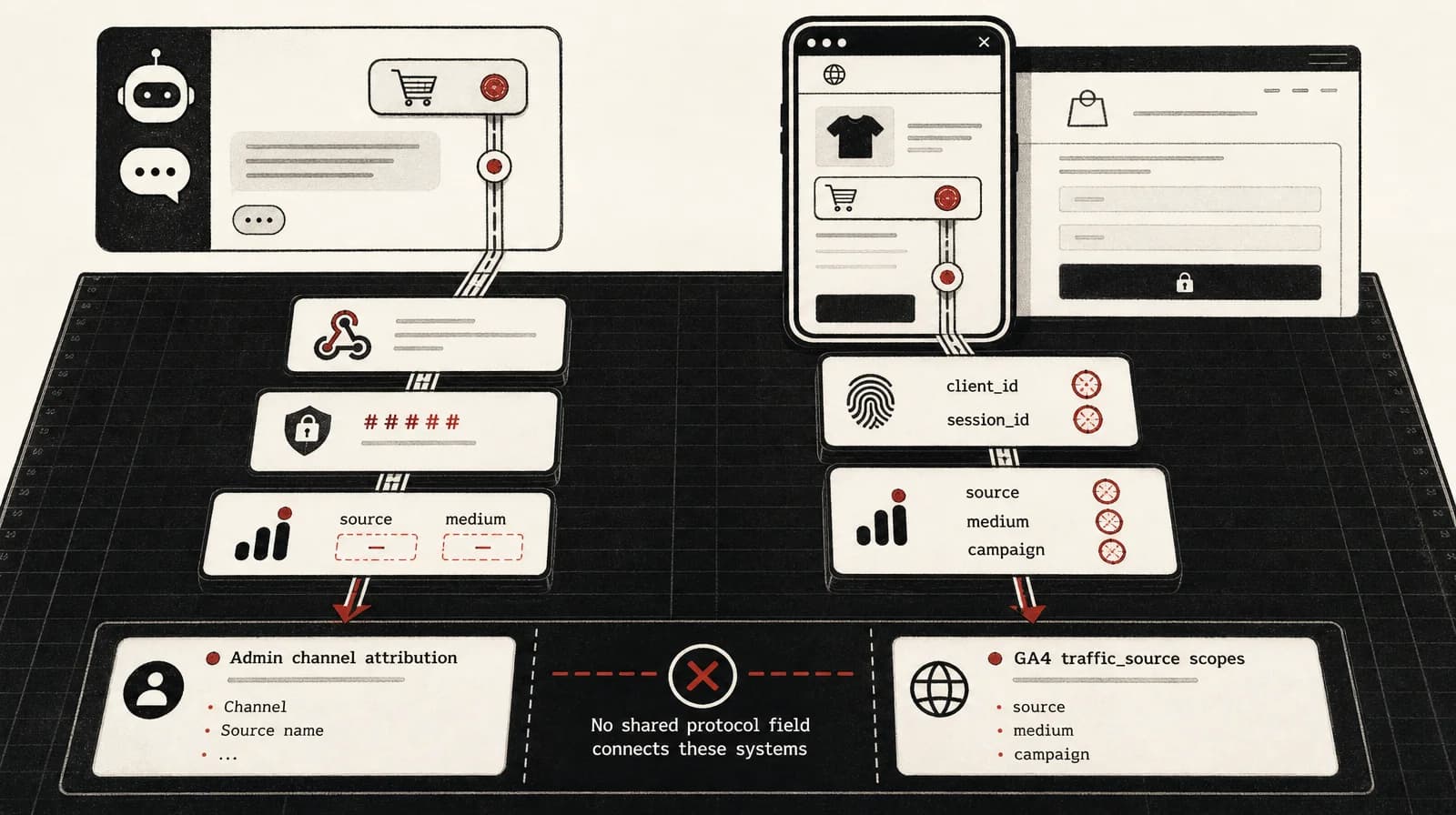
AI referral traffic shows as Direct in GA4 when no referrer survives the click, site referrer policy, in-app and mobile browsers, copy-paste and link-tracking protections all strip the signal, and GA4 then applies its Direct rule.
The native AI Assistant channel only fires on a recognised referrer, so the AI number is a floor.
Vendor cohorts are not comparable and must not be averaged: one April 2026 customer-site cohort put about one-third of AI sessions in Direct (35.7% of 371,847 AI sessions arrived with no referrer); another, using its own ChatGPT attribution baseline across 200 sites, put roughly 70% of those sessions in Direct/(none).
There is no independent ecommerce share in the public sources.
You cannot separate AI Overviews or AI Mode clicks from normal Google organic in GA4: Organic Search is defined to include both, and the referrer is google.com either way.
Search Console's generative AI report (from 3 June 2026, beta subset) gives impressions only, no clicks, CTR, position, query or revenue, so it cannot be joined to sessions.
The AI Assistant channel does not replace a custom channel group and does not backfill.
It launched on 13 May 2026, rolled out gradually (broader availability around 7 June 2026), overwrites medium to ai-assistant and campaign to (ai-assistant) on a recognised referrer, and leaves pre-rollout sessions in Referral or Direct.
Run both groupings in parallel, annotate the rollout date, verify the live recognised-assistant list yourself,
If you run a D2C property in GA4, you are probably holding three questions at once. Why are AI referrals landing in Direct, and how much of that traffic never appears as AI at all? Can you split Google AI Overviews and AI Mode clicks out of Organic Search? And does the new AI Assistant channel let you retire a custom channel group, and will it rewrite history?
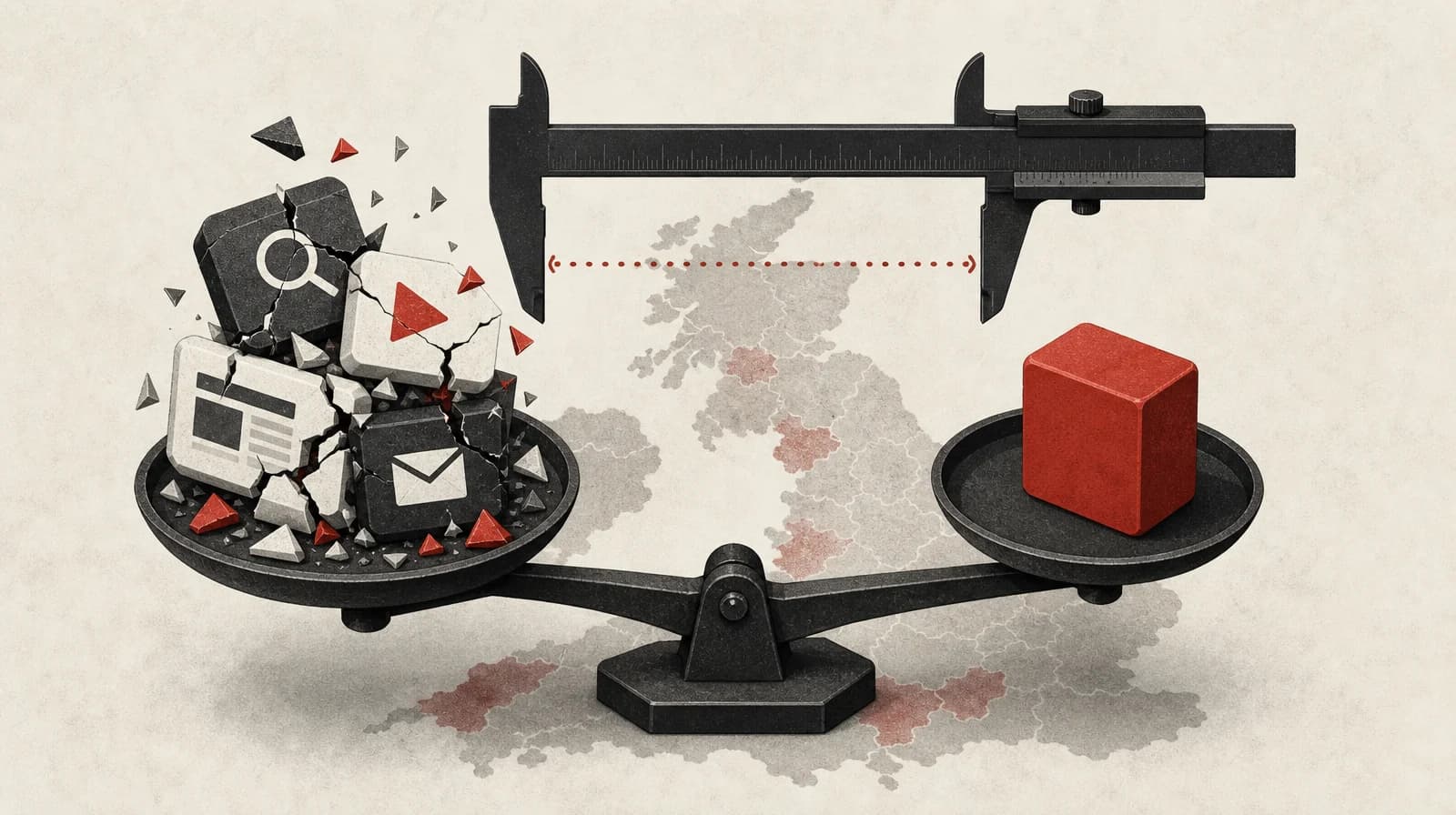
Those are not three separate product updates. They are one reporting-continuity problem. GA4 now automatically classifies some recognised assistant referrals into a native channel, still drops referrer-stripped clicks into Direct, and explicitly defines Google's own AI surfaces as Organic Search. Any comparison that spans the rollout date will move volume between channels even if demand did not change.
What does this misclassification cost commercially?
The cost is not that an "AI channel" exists. It is that channel mix, organic contribution and Direct are still being read as if their definitions were stable.
When recognised assistant traffic moves from Referral into AI Assistant, Referral looks weaker after the rollout for definitional reasons. When AI Overview and AI Mode clicks sit inside Organic Search, organic looks healthier than blue-link demand alone. When a material share of assistant clicks arrives with no referrer, Direct absorbs them and the AI figure you put in a pack is a floor, not a census.
That matters for any operator who reads blended media efficiency beside channel contribution, or who has to explain a mid-period channel that appears to have "launched" when the underlying visits were already happening. A board pack that treats the new channel as incremental demand, or a Referral decline as a media problem, will mis-state the business.
There is no ecommerce-specific or D2C-specific share of AI-sourced sessions, revenue or AOV in the public sources for this piece. Do not fill that gap with a vendor conversion multiple or a borrowed average order value. The decision in front of you is definitional: what you can claim, what you must caveat, and what you cannot split.
Treat native AI Assistant as a floor. Direct still holds leakage, so finance should not write it off as leftover. Vendor Direct-share cohorts disagree with each other; do not rest a commercial claim on them.
Why have the usual workarounds not closed the gap?
Three common approaches fail for structural reasons, not because the implementation was sloppy.
The first is a regex custom channel group. Google documented that pattern in August 2025, naming ChatGPT, Gemini, Microsoft Copilot, Claude and Perplexity as examples. It still has three concrete drawbacks: you maintain the regex by hand, you need editor-level access to change it, and GA4 only allows two custom channel groups. It also cannot catch sessions that arrive with no referrer, because there is nothing to match.
Keep the regex to assistants that actually send referrers you can see. Do not pad it with omitted names just because the help page listed them.
The second is treating a rising Direct bucket as unexplained brand demand, then hunting landing pages after the fact. Some of that Direct is genuinely unattributed. Some of it is assistant traffic whose referrer was stripped by site policy, in-app browsers, copy-paste or link-tracking protections. GA4's Direct rule is the absence of a recoverable source signal, source (direct) with medium (not set) or (none). A Direct investigation that never looks for assistant landing-page patterns will keep calling stripped AI clicks "brand".
The third is assuming the native AI Assistant channel is the complete answer. It is automatic: on a recognised referrer it overwrites the traffic-source dimensions, sets medium to ai-assistant, sets campaign to (ai-assistant), and groups the session under AI Assistant in the Default Channel Group. You do not configure it. Default channel groups also cannot be edited. But the classifier only fires on a recognised referrer, omits assistants that are not on Google's list, does not reprocess history, and does not touch Google's own AI surfaces at all.
Trying to split AI Overviews or AI Mode with another custom group or a third-party tool fails for the same reason: those clicks carry a google.com referrer identical to a blue-link click. No grouping rule can separate identical source/medium pairs.
Is this three product updates, or one continuity break?
Diagnose the decision as an audit trail, not as a feature checklist.
Ask, for each class of session: did GA4 receive a referrer, is that referrer on the recognised list, and which instrument, if any, can see Google's own generative surfaces? The answers produce five different landing places, not one "AI traffic" number.
Recognised assistants that still pass a referrer now sit in AI Assistant, from the date the channel became available on that property. The same assistants with the referrer stripped sit in Direct. Assistants that pass a referrer but are not on the list sit in Referral, Perplexity is the documented example in current secondary readings of the help page, via a perplexity.ai referrer. AI Overviews and AI Mode sit in Organic Search. Search Console's generative AI report can show impressions for those Google surfaces, but not clicks or revenue.
That is why a single row in Traffic acquisition cannot answer the three operator questions. The native channel improved the audit trail for a subset of future assistant referrals. It did not make AI measurable as a whole, and it introduced a dated break in the series. Treating retrieval, classification and judgement as separate jobs is the same discipline you already need when AI changes D2C research: the tool organises a signal; the operator still owns the definition.
How should you classify and report AI-sourced sessions now?
Use a protocol you can paste into a reporting doc, then keep two groupings in parallel until you have tested what actually reprocesses on your property.
- Verify the live recognised-assistant list on Google's Default channel group help page on the day you report, and date-stamp it. Do not copy a launch post.
- Annotate 13 May 2026 as the AI Assistant classification start, and note that availability was staggered, with broader appearance in standard reports around 7 June 2026.
- Keep the custom channel group. Add an OR condition so Default channel group exactly matches AI Assistant. Do not delete the custom group.
- Treat any claim that a custom channel group reclassifies pre-rollout history as unverified against Google documentation until you have tested it on the property.
- Report native AI Assistant figures as a floor. Referrer-stripped clicks remain in Direct.
- Do not attempt to split AI Overviews or AI Mode out of Organic Search in GA4. Use Search Console generative AI impressions only, and do not join them to sessions or revenue.
- For Direct leakage, compare server logs (assistant referrers, excluding known bots) with GA4 Direct/(none) by landing page. Deep-page entries nobody would type are the practical tell.
- In stakeholder copy, state that channel movement across the rollout is definitional, not behavioural.
The recognised-platform list is the first place secondary coverage will trip you. Launch reporting on 14 May 2026 named ChatGPT, Gemini and Claude as examples. Later readings of the live Default Channel Group documentation named ChatGPT, Gemini, Deepseek, Copilot and Grok, and stated that Claude and Perplexity were not on that list. At least one later explainer still listed Perplexity as included. At launch, Google had not published the full recognised-referrer list or said how it would be updated, and the definitions table itself lagged the product. Google's help page is the primary source; it hosts a downloadable spreadsheet of default-channel-group sources and a contact address for listing-change requests, which Google says are reviewed at least annually and often more often. Check that page on the day you write the pack. If the list has moved again, date-stamp the change rather than arguing from memory.
That "no" is the cleanest of the three answers, and it is definitional rather than a tooling gap. Secondary readings of Google's Organic Search definition now include AI Overviews and AI Mode. AI Overview, AI Mode and blue-link clicks all classify as source google, medium organic, channel Organic Search. Clickport, whose own product sits in this category, states the same limit and includes itself in it: no tool can split those clicks. The nearest Google-owned instrument is Search Console's generative AI performance report, announced on 3 June 2026. It shows impressions from AI Overviews and AI Mode, with the URLs that appeared and breakdowns by country, device and date. It does not show clicks, CTR, average position, citation placement, the supporting passage, or conversion or revenue. Experimental Search Labs features are excluded. The initial rollout was to a subset of site owners. Google has said it is still deciding which further metrics to add. Until clicks exist, those impressions cannot be joined to GA4 sessions.
A shared definitions table belongs in the reporting doc, not in a slide footnote:
| Surface | Where it lands in GA4 | What identifies it | What else measures it |
| --- | --- | --- | --- |
| Recognised assistant, referrer present | AI Assistant, from property availability | Medium ai-assistant; campaign (ai-assistant); Default channel group AI Assistant | Your custom group, if you keep one |
| Recognised assistant, referrer stripped | Direct | Source (direct); medium (not set) or (none) | Server logs versus landing page |
| Assistant off the recognised list (Perplexity in current documented readings) | Referral | perplexity.ai referrer | Custom regex; verify the live list |
| AI Overviews | Organic Search | Source google, medium organic | Search Console generative AI impressions (subset; no clicks) |
| AI Mode (current behaviour) | Organic Search | Source google, medium organic | Same Search Console report |
Two caveats belong next to that table. First, Perplexity's placement is only as good as today's help page, re-check it. Second, AI Mode's referrer behaviour has already changed once. In May 2025, AI Mode links briefly carried rel="noopener noreferrer", which pushed that traffic into Direct until Google fixed it within days. Current documentation treats AI Mode as a normal google.com referrer inside Organic Search. Anyone doing long-range year-on-year organic comparisons needs that 2025 episode annotated so a short Direct spike is not read as a demand shift, and so later write-ups that still describe AI Mode as referrer-stripping are not copied into a 2026 pack.
Does the native channel replace the custom group? Not yet. It stops you maintaining regex for recognised platforms, and you do not need editor access to keep those platforms classified. It still misses omitted assistants, does not publish the full referrer list, does not catch no-referrer clicks, and does not reclassify history. Operators who have already wired this keep the custom group and add an OR condition on Default channel group that exactly matches AI Assistant, so both definitions are captured. Run them in parallel until you know what the custom group does to old sessions on your property. If you have not tested whether a custom channel group reclassifies sessions from before 13 May 2026 against native AI Assistant, do not treat the custom group as a retroactive bridge. Compare both going forward.
Useful for
- Automatic classification on recognised referrers, with no configuration
- Reserved medium ai-assistant and campaign (ai-assistant) give a stable label in the Default Channel Group
- Removes regex maintenance for platforms Google already recognises
Watch for
- Forward-only from 13 May 2026 per property; no native backfill
- Unrecognised assistants still land in Referral
- No-referrer assistant clicks still land in Direct
- AI Overviews and AI Mode remain inside Organic Search
- Full recognised-referrer list and update cadence are unpublished
What does the public evidence actually support?
Confidence should be stated per question, because the evidence is uneven.
Why AI referrals show as Direct, high confidence on the mechanism, not on the share. The AI Assistant channel fires only on a recognised referrer. Everything else with no recoverable source signal is Direct. Documented stripping mechanisms include the site's referrer policy (including ChatGPT's strict-origin policy on chatgpt.com), noreferrer on some paid-tier links, ChatGPT's iOS and Android in-app browsers, mobile Safari tracking protections including iOS 17 Link Tracking Protection, and copy-paste. A small Clickport server-log illustration makes the magnitude tangible without pretending to be a market figure: 56 Gemini-on-iOS visits appeared as five GA4 referrals. That is a single vendor study with a tiny sample; cite it as an illustration of referrer loss, not as a rate.
How much are you missing, low confidence in any single percentage. Two vendor cohorts disagree, use different denominators, and must be shown side by side, not blended.
Do not average one-third and 70%. They are not the same population, not the same attribution baseline, and not an ecommerce census. No independent, non-vendor measurement of the misattributed share exists in these sources. The usable move is the self-diagnostic: grep server logs for assistant hostnames excluding known bots, then filter GA4 to Direct/(none) and segment by landing page. Deep URLs that a typed-in visitor would not request are the stripped-referrer tell. Attrifast also notes a real-time backfill delay that can make day one look worse than steady state, do not diagnose leakage from a single early session sample.
Can you separate AI Overviews and AI Mode from organic, high confidence that you cannot, in GA4. The definition and the identical referrer are the whole argument. Search Console impressions are a parallel instrument, not a join key. Google is also testing a Search Console control to include or exclude content from AI Overviews, AI Mode and generative features in Discover without removing the site from traditional search; the default is inclusion. That is a content-policy decision, not a measurement split.
Does the native channel replace the custom group, and does it backfill, high confidence on "no" for backfill; "not yet" for replacement. Google's What's New documentation and multiple launch write-ups date the channel to 13 May 2026. Classification is forward-only. Traffic before that date stays as Referral, Direct or whatever custom grouping you already had. Availability was staggered; more properties were seeing the channel populate in standard reports around 7 June 2026. Absence of the row is not necessarily a setup fault. Because Default Channel Group cannot be edited, you cannot make the native definition retroactive by hand.
Several secondary sources imply or state that a custom channel group can classify historical traffic the native channel cannot. That claim is not verified against Google documentation in this source set. Test it on the property before you put a bridged trend in a board report. Until that test is done, the only honest comparison protocol is: annotate the rollout date, keep the parallel custom group as a candidate bridge, and refuse to read Referral's post-rollout decline as a demand change.
What this evidence does not support is equally important. There is no confirmed method to split AI Overviews from blue links. There is no public full referrer list and no stated update cadence. There is no confirmation of if or when Search Console will add clicks. There is no evidence here on how the AI Assistant channel appears in the BigQuery export, the Data API or Looker Studio historical tables, do not assert parity. Consent mode, server-side GTM and Shopify or headless setups are out of scope for this piece. Widely repeated AI conversion-rate multiples and AI Overview query-coverage percentages appear only via unverified vendor summaries in these results and are omitted.
What should change in the next reporting pack?
Open the next pack at the date, not at the channel name.
Write 13 May 2026 (and, if the property lagged, the date the row first populated) into the annotations. State that AI Assistant is a classification change for some future recognised referrals, not a new acquisition product. Keep the custom channel group with an OR on Default channel group = AI Assistant. Label every AI Assistant total as a floor. Put Direct and Organic Search next to that floor so stripped referrals and Google's own AI surfaces are visible as residual risk, not as a mystery. Verify the recognised-assistant list against the live help page on the morning you send the pack.
If a period spans the rollout, show Referral and AI Assistant as a paired series with the break marked, rather than a month-on-month Referral percentage that will look like a decline. If someone asks whether organic "improved" after AI Overviews expanded, answer with Search Console generative AI impressions if the property has them, and with an explicit statement that GA4 cannot split those clicks from blue links. Do not restate a definitional migration as performance.
When a reporting period spans the AI Assistant rollout, annotate Referral and AI Assistant as a definition change, not a demand change. The board should not read the shift as traffic arriving or leaving.
That is the next useful action: lock the definitions, annotate the break, and stop asking a single GA4 channel to do work the data model cannot do.
Sources
- Default channel group – Analytics Help (Google) support.google.com Default channel groups cannot be edited.
- Google Analytics Adds AI Assistant As Default Channel Group – Search Engine Journal (14 May 2026) searchenginejournal.com Launch: medium ai-assistant, reserved campaign (ai-assistant), automatic grouping under AI Assistant; examples named ChatGPT, Gemini and Claude.
- AI Traffic in GA4: How ChatGPT, Perplexity, Gemini & Google AI Mode Referrals Actually Show Up (10 July 2026) nicelookingdata.com Organic Search documentation includes AI Overviews and AI Mode; those clicks classify as source google, medium organic.
- GA4's New AI Assistant Channel: Measure AI Traffic – Digital Applied (11 June 2026) digitalapplied.com 13 May 2026 launch via What’s New; medium ai-assistant, campaign (ai-assistant); broader availability around 7 June 2026.
- GA4 AI Assistant Channel: How to Track Chatbot Traffic – GA4 Optimizer (9 June 2026) gaoptimizer.com On a match, GA4 overwrites medium, campaign and Default Channel Group.
- GA4 AI Assistant Channel: What It Is and How It Works – Data Clare (21 June 2026) dataclare.com Automatic, no-configuration, staggered rollout; missing channel is not necessarily a setup fault.
- GA4 AI Assistant Channel: What It Still Can't See – Clickport (12 June 2026) clickport.io Channel fires only on a recognised referrer; no-referrer AI still Direct.
- Why ChatGPT Traffic Shows as Direct in GA4 – Clickport (21 May 2026) clickport.io April 2026 customer sites: roughly two-thirds of ChatGPT traffic in Referral, about one-third in Direct; 371,847 sessions, 35.7% of AI traffic had no referrer.
- ChatGPT Referral Traffic Not Showing in Analytics? Here Is the Diagnostic – Attrifast (26 May 2026) attrifast.com Across a 200-site cohort, roughly 70% of sessions Attrifast attributes to ChatGPT are reported by GA4 as Direct/(none); vendor-measured baseline.
- Google Now Reports AI Search Impressions. Here's How To Read Them – Search Engine Journal (June 2026) searchenginejournal.com 3 June 2026 generative AI performance reports for Search and Discover; Search report shows AI Overviews and AI Mode impressions by URL, country, device and date.
- Google Fixes AI Mode Traffic Attribution Bug – Search Engine Journal (May 2025) searchenginejournal.com Historical episode only: AI Mode links carried rel=noopener noreferrer and reported as Direct until Google fixed it within days.