Key takeaways
Build or repair welcome or post-purchase first.
Choose between them using the customer experience and store data, fix logic before copy, and leave abandoned-cart and browse recovery until the foundation works.
Start with welcome or post-purchase. That is the customer you have already paid to acquire.
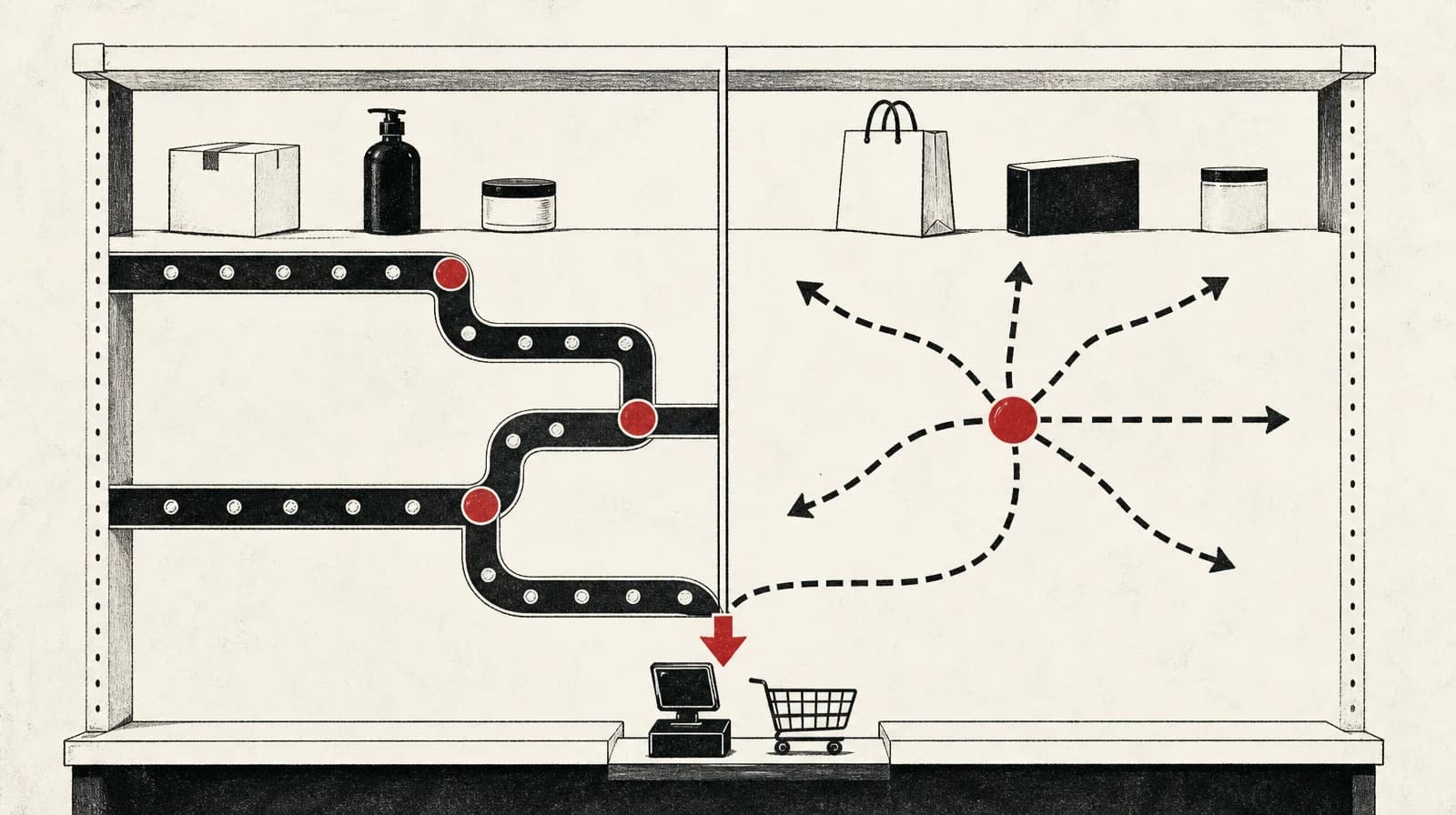
Welcome begins the relationship the business paid to create. Post-purchase has to make the first order feel like the start of something worth continuing. If either journey is missing or broken, buying more clicks and recovering more abandoned intent sends people into a brand experience that has not earned them.
The brand is built after the click, not in the ad.Eddie Cheng, Ecommerce operator
Use the store's own customer and order evidence to choose between those two starting points. Then use the same evidence to rank the rest of the repair queue. The default is deliberate, but it is not an excuse to ignore a broken trigger, a consent failure or another fault that can harm customers now.
What counts as a lifecycle flow?
A lifecycle flow responds to a customer state or action. The trigger might be a subscription, product view, basket, checkout, first order, repeat order or a period without purchase. The message is meant to help the customer take a sensible next step.
Shopify's current marketing automation documentation separates product-browse, cart, checkout, welcome, post-purchase, win-back and customer-appreciation automations. That list is useful because it makes the different jobs visible.
A browse message helps a visitor return to a product. A checkout message helps someone complete an order they started. A welcome sequence sets expectations after subscription. A post-purchase flow can answer ownership questions, ask for feedback or prepare a relevant next purchase. A win-back flow tests whether a lapsed customer still wants a relationship with the brand.
They should not be judged as interchangeable email assets. Each has a different eligible audience, delay, customer need and commercial outcome.
The flow map should record:
- The entry event.
- Eligibility and exclusion rules.
- Consent basis for the channel and market.
- The intended customer action.
- Timing and exit conditions.
- Product or order data used in the message.
- The destination after the click.
- The event that records success.
Without that map, teams often compare open rates across flows that do entirely different work.
Is the flow missing, broken or merely weak?
These are three different problems.
A missing flow leaves an important customer state with no planned response. A broken flow exists but fails mechanically. A weak flow sends as designed but does not help enough customers take the intended action.
Check them in that order. There is little value in debating a subject line before confirming that the right people enter the automation.
Mechanical failures include:
- A checkout event no longer firing after a site change.
- An exclusion rule removing eligible customers.
- Product data rendering empty or showing an unavailable item.
- Messages being suppressed, bounced or routed incorrectly.
- Links losing the basket or checkout state.
- A customer continuing through the flow after completing the desired action.
- Revenue being credited under a different window from the rest of the report.
Weakness needs a more careful diagnosis. A low click rate may reflect an irrelevant message, but it may also reflect that the message did its job without a click, that the audience is too broad or that the destination fails after interest is created. Start with the customer action and work backwards.
Which customer transition is worth the most?
Commercial value is not the revenue attributed to the flow dashboard. It is the value of recovering or improving the customer action after the business accounts for who was eligible and what would probably have happened anyway.
Begin with four questions:
- How many customers reach this state?
- What is the intended next action worth to the business?
- How severe is the current failure?
- How confident are we that the flow is the cause?
The eligible audience protects the team from fixing a dramatic problem that affects almost nobody. The value of the next action stops high-volume but low-consequence activity taking over the queue. Failure severity separates a small optimisation from a flow that does not send. Diagnosis confidence prevents a full rewrite when the checkout or product is responsible.
Do not turn those questions into a decorative score that hides judgement. Keep the underlying evidence beside the priority. A short note such as "high checkout entry, trigger failure confirmed, order completion at risk" is more useful than an unexplained 92 out of 100.
Why do abandoned checkout and browse wait?
Checkout and browse recovery sit close to purchase intent, which makes their attributed revenue easy to see. That proximity does not make them the first brand system to build.
Shopify describes abandoned-checkout automation as a message to customers who start checkout without completing an order. Its documentation also notes that eligibility can depend on subscription settings and other conditions. The reported audience is therefore not every person who left a checkout page.
The operating order here is welcome or post-purchase first, then abandoned-cart and browse recovery. The business has already paid to create the subscriber or customer relationship. It should make that experience dependable before it gives the recovery dashboard priority.
Recovery still deserves technical monitoring. If a live trigger is sending the wrong product, ignoring a completed purchase or breaking consent rules, repair the fault immediately. That is customer protection, not a decision to put recovery strategy ahead of the foundation.
When recovery reaches the queue, check:
- How many valid checkout abandonments enter the flow?
- Are customers excluded because of consent, product availability or a later purchase?
- Does the recovery link preserve the correct basket and market?
- Are payment, shipping or discount problems causing the abandonment?
- Would repairing checkout remove more loss than editing the follow-up?
- How many attributed orders would have returned without the message?
If the trigger is broken, repair it. If customers abandon because delivery information appears too late, fix the store experience too. A follow-up message is an expensive place to explain something the checkout should have made clear.
How do you choose between welcome and post-purchase?
Welcome moves up the queue when the brand is acquiring subscribers at meaningful volume and failing to set a useful first expectation. The intended action may be a first purchase, but the sequence also decides what the person understands about the product, service and frequency of contact.
Post-purchase moves up when the first order creates questions or preventable friction. A message can explain product use, delivery, care, exchanges or what happens next. It can also collect feedback that shows why customers do not return.
Do not force a second purchase before the first experience has earned one. A post-purchase flow that jumps straight to another discount may record revenue while avoiding the reason retention is weak.
Customer cohorts help reveal this problem. Shopify's customer cohort report groups customers by first-order date and shows their repeat purchasing in later periods. That view can separate a healthy aggregate returning-customer rate from a recent cohort that behaves differently.
Use cohorts as a direction finder, not proof that one email caused retention. Compare the customer groups exposed to different products, offers, markets and post-purchase experiences. Then decide whether the flow is the most plausible intervention.
The broader article on blended media efficiency uses the same principle: an aggregate can raise the question, but the mix underneath it explains the decision.
Are consent and deliverability hard gates?
Yes. Consent and suppression rules take priority over the potential return from a flow.
Email and SMS rules vary by market and relationship. In the UK, the ICO's electronic-mail marketing guidance explains the PECR rules, including consent, the applicable soft opt-in and a person's ability to change their mind. The business should map its own markets and obtain legal advice where the rule is unclear.
The operating review should confirm:
- How consent was collected.
- Which channels and message types it covers.
- Whether a soft opt-in is being used and why it applies.
- How suppression and unsubscribe choices move between systems.
- Whether the automation can send after the customer leaves the eligible state.
- Who owns a compliance or deliverability failure.
Deliverability also changes the priority. If sending reputation, authentication or suppression handling is broken, repairing one high-value flow in isolation may not help. The shared channel problem belongs ahead of its dependent flows.
Should you fix logic or copy first?
Repair the system before polishing the message.
Use this order:
- Confirm the entry event and eligible audience.
- Check consent, suppression and message delivery.
- Verify timing, exits and product or order data.
- Open every destination on a phone and complete the intended action.
- Reconcile the success event with commerce and customer records.
- Only then revise the offer, sequence and copy.
Copy matters after the customer receives the right message at a useful moment. At that point, read the message against the action it is supposed to support.
Does it answer the customer's next question? Does the product shown remain available? Does it introduce a discount the original journey did not require? Does it send the customer back to a generic homepage rather than the state they left? Does the sequence stop when the action is complete?
Lifecycle copy often becomes long because the flow has no clear job. One message tries to educate, recover, cross-sell and tell the brand story. Give each step one reason to exist.
How do you compare flows without trusting attributed revenue?
Attributed revenue is one input. It is especially vulnerable to audience and timing differences across flows.
A checkout flow naturally sits close to an order. A welcome message may influence an order later. A post-purchase education message may reduce returns or support contacts without receiving any order credit. Comparing only the revenue displayed beside each automation rewards proximity.
Use the same reporting split described in ROAS or profit: channel attribution can help diagnose delivery, while the business's own contribution view judges the commercial result. A flow should not receive more priority merely because its reporting window claims more orders.
Build a small review table:
| Flow | Eligible customers | Delivery health | Intended action | Action rate | Commercial note | Confidence | | --- | --- | --- | --- | --- | --- | --- | | Checkout | Valid abandoned checkouts | Sent, suppressed, failed | Complete order | Defined consistently | Net contribution and likely recovery | High, medium or low | | Welcome | New consented subscribers | Sent, suppressed, failed | First useful action | Defined consistently | First-order value or engagement | High, medium or low | | Post-purchase | Eligible first orders | Sent, suppressed, failed | Successful ownership or repeat action | Defined consistently | Repeat value, returns or support | High, medium or low | | Win-back | Lapsed eligible customers | Sent, suppressed, failed | Return without harmful discounting | Defined consistently | Reactivation contribution | High, medium or low |
Keep the definitions visible. If one row counts a click and another counts an order, the table should say so.
Where volume allows, use holdouts or controlled changes to learn incrementality. Where it does not, use a narrower claim. "The repaired trigger restored coverage" may be defensible before "the flow created all attributed revenue" is.
What should enter the repair queue?
The queue should contain customer problems, not a list of flow names.
For each item, write:
- Customer state and intended next action.
- Evidence of the failure.
- Eligible audience affected.
- Commercial consequence.
- Proposed repair.
- Owner and review date.
- Measurement and confidence level.
- Dependencies on the site, data or legal review.
Then choose the smallest repair that tests the diagnosis. A missing exit rule may take an hour. A weak post-purchase experience may require changes to packaging, support and product content before a sequence can fix anything. Treating both as "email tasks" leads to poor estimates and shallow solutions.
Who owns problems shared by several flows?
Some failures sit below the individual automation. Fixing one message will only hide them for a week.
Identity and consent data, product availability, order status, link construction, sender authentication and event naming can affect several flows at once. When the same symptom appears in more than one journey, move the shared dependency above the individual copy tasks.
Assign one owner to the dependency and keep the affected flows attached to it. The lifecycle manager may describe the customer impact, but an ecommerce developer, data owner or legal reviewer may need to make the repair. Ownership should follow the system that can change the condition.
This also changes how the team measures completion. A new template is not finished if suppression choices still fail to sync. A repaired checkout flow is not finished if an unavailable variant continues to enter the message. Close the item only after a real test customer enters, receives, exits and records the intended event under the same conditions as the live audience.
Keep a small regression list for shared dependencies. Run it after checkout changes, migration work, consent updates and product-data changes. Lifecycle flows are quiet when they fail, so waiting for attributed revenue to drop can leave the problem hidden for too long.
Which flow goes first?
Welcome or post-purchase goes first. Choose between them by locating the larger break in the experience the business has already paid to create.
Check the trigger and eligibility before looking at creative. Respect consent and suppression as hard boundaries. Use cohort and commerce data to decide whether the subscriber journey or ownership experience needs attention first. Then rank abandoned-cart, browse, win-back and other flows by the customer problem they can genuinely repair.
Once the first repair ships, keep its assumptions. The queue should change when the evidence changes, not when a new template looks more interesting.