Key takeaways
Awin automatically credits one Awin partner, provided you are not also running partner activity on another affiliate network. impact.com says to store im_ref in a first-party cookie or on the server, and the cookie's lifetime must match the referral window in the contracts.
A successful call is queued for processing.
Judge the platform on one paid order: which partner or channel can take a commission on it, and whether that row can be matched to the shop. Awin and impact.com publish enough of the mechanism to show what to demand in a reply. These pages do not rank other networks.
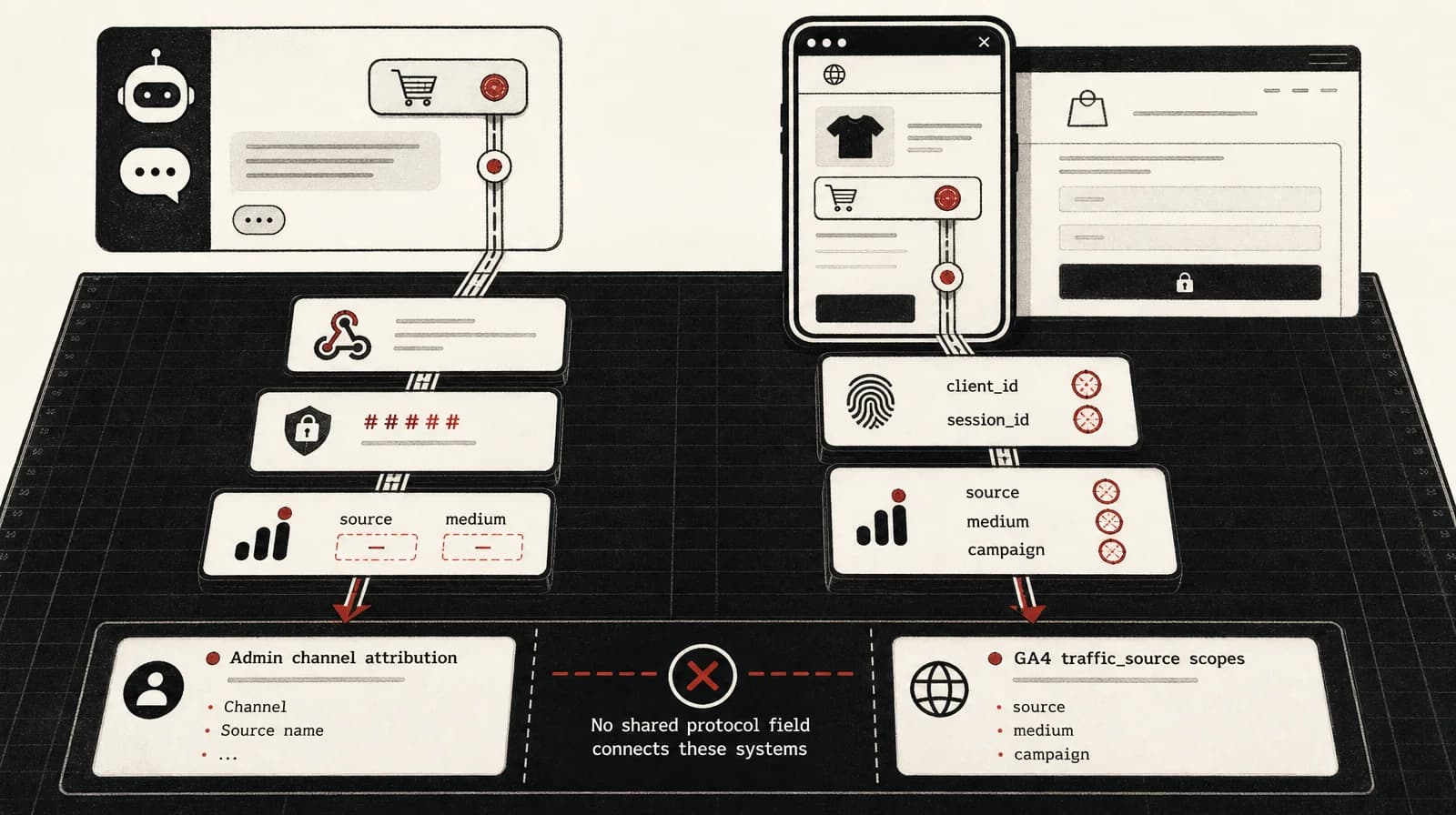
Where Awin's automatic de-duplication stops
Awin's tracking overview lists its de-duplication page as published on 9 March 2026. That page says: "De-duplication ensures that only one partner is credited for a sale, preventing multiple commissions for the same transaction. Awin's tracking system automatically manages this, provided that you are not running partner activity on another affiliate network."
The proviso is the part to test. Automatic credit, on that wording, is between Awin partners. A second network sits outside it. Awin's advertiser FAQ states that the functionality it describes is currently available only on Awin Classic. On that page, Awin automatically de-duplicates sales between Awin partners, and the advertiser may want separate rules to exclude other marketing channels. Those rules are pre-defined conditions that decide which tracking tag is shown on the confirmation page, so the sale is awarded to the last-click affiliate or to another channel.
A November 2013 Affiliate Window PDF warned that, if conditional tracking is not in place, an advertiser could pay two affiliates for the same sale. That warning is old, so check it against Awin's current pages before you rely on it.
Awin also says the de-duplication policy has to sit in the programme terms and conditions, where partners can read it, and that the choice of channels to de-duplicate against may affect partner behaviour.
What Awin means by de-duplication
On that same de-duplication page, Awin describes the job as a method to determine which channel is awarded a sale, and states that de-duplication is not an attribution model.
impact.com's online-sale implementation guide describes a different moment. When the brand sends conversion data to the Conversions endpoint, impact.com determines attribution, awards it to a partner, and creates a new pending action. The guide used here doesn't say how that award is chosen when two impact.com partners both have a claim. "Awarded" in the Awin sentence is a channel decision. "Awarded" in the impact.com sentence is a partner decision that then waits. Reading either page as a full attribution model overclaims what it contains.
A refresh, a mismatch, and a queue
Awin's glossary uses duplicate commission for a commission that has appeared on the advertiser control panel more than once, normally because a visitor refreshed the confirmation or thank-you page. A refresh of that page can create the extra commission row.
The glossary uses discrepancy for a difference between the statistics recorded for the same ad on two ad serving systems, with a publisher's ad server and an agency's ad server as the example. That entry does not, by itself, mean two partners were paid, and it does not define a gap between a shop export and a network export.
impact.com's conversions reference says a successful response means the conversion event has been successfully queued for processing. The implementation guide calls the result a new pending action. Both describe intake, so confirm the steps from there to approval and payment.
The click identifier still has to be stored
impact.com's tracking help page defines API tracking as a non-pixel method that reports conversions through the impact.com API. It notes that this is sometimes called cookie-less tracking or server-to-server tracking.
The API introduction is specific about the identifier. The site captures the im_ref query string value and stores it in a first-party cookie or on the server. The effective lifetime of the cookie must match the referral window in the contracts. impact.com describes that window as typically 30 days. That figure is impact.com's description of its own norm, not a benchmark for other contracts.
Server-side reporting drops the conversion pixel. impact.com still requires the site to capture im_ref and store it in a first-party cookie or on the server. The cookie's effective lifetime must match the referral window in the contracts. If a proposal calls the method cookie-less, find where im_ref, or that vendor's equivalent, is written, and what deletes it.
On the same help page, impact.com says API tracking is fully ITP compliant and is becoming the standard and recommended tracking solution for brands. Treat that as impact.com's claim, and ask which browser behaviour it refers to.
The help page also describes FTP as another version of server-to-server tracking. The file still needs a stored identifier when it is built.
Conditional firing and a channel flag
Awin's docs describe two trails, and each page recommends its own method.
One de-duplication article says that when the purchase completes, the tracking system references the last recorded source ID and uses it to decide which tracking tag to fire. If only that tag fires, the other network doesn't get a confirmation-page record of the order. You may have nothing to reconcile on the losing side.
The developer docs recommend the other trail. Awin tracking should be displayed unconditionally, except on pages that display or process personal data, and the channel parameter should tell the system what to do. Deduplication, on the same page, is necessary when you work with multiple marketing channels or networks, so that commission is not paid out to multiple traffic sources. That commission point is the reason given for deduplication, not for displaying the tag unconditionally. In that setup Awin can see the order and still be told not to pay. Ask which trail the implementation uses, and keep a sample of the record the losing channel does or doesn't receive.
The sample code on that page sets iCookieLength to 30 for last-click referrer de-duplication, without presenting 30 as a recommended window.
Awin says de-duplication functionality comes as standard with the Shopify app. Ask how that app is set up, and whether the setup also covers a second network or another paid channel.
Order fields, keys, and a $15 discount
The conversions reference requires one attribution key from this list: ClickId, CustomerId, CustomProfileId, CustomClickId, PromoCode, MediaId / MediaPartnerId, UniqueUrl, CallerId, GoogAId, AndroidId, AppleIfa, or AppleIfv. PromoCode is on the list, so a code can be the key that lets the conversion in, with no click ID supplied. On that path, a coupon can credit a partner without a stored click. Ask how a code is prioritised against a stored click.
The online-sale example call passes OrderId, OrderDiscount, OrderPromoCode, and item SKU and subtotal fields. Because OrderId is there, a match to the shop's order export is technically possible. Nothing on the page shows that a particular brand runs that match.
Discount handling is specified in one concrete case. The implementation note says impact.com will take the $15 discount passed and apply that proportionately to all items in the purchase. The $15 is the US-dollar amount in that example, so read it as a worked discount rather than a fee or a measured rate of code use. Ask whether commission is calculated after that spread, and ask to see the item lines rather than a single order total.
Before you sign, check a reported conversion against the shop order.
Check one order before you sign
Run this before you sign. The steps below are a buying method built from the documents cited above. Neither vendor published this list as a procurement checklist.
- Place one test order with an order ID you choose, a discount, a promo code, and a stored click identifier whose age you know.
- Confirm the row appears in the platform account and that the amounts match the shop order.
- Export both sides and match on order ID.
- On Awin, check the rule for a second network or another paid channel. The functionality described in the advertiser FAQ is currently available only on Awin Classic.
- Note whether the confirmation page fired one tag or Awin's tag with a channel parameter, and save the record the losing side receives, including if it receives nothing.
- Record the status after the call. Queued or pending means accepted for processing, so follow the row through approval and payment, and note what a refund does.
Commission against cash left, on invented figures
The pounds in this section are invented, so a commission and a fee can be set next to cash left on one order. No fee schedule for Awin, impact.com, or any other platform was verified, and none is implied here. The discount rule is the part taken from the documentation: impact.com applies a passed discount proportionately to all items, and its note uses a $15 discount. This illustration uses that proportionate rule on invented sterling prices. Tax, shipping and payment processing are left out.
Item A is £40 and item B is £60, so the gross is £100. The discount passed is £15. A is 40% of the gross and bears £6. B bears £9. The nets are £34 and £51. The commissionable total is £85.
Assume an affiliate commission of 10% of that £85, which is £8.50, and a platform fee of 3% of the same £85, which is £2.55. Together that is £11.05. If the customer paid the discounted amount, cash collected is £85. Cash left after those two charges, and before goods and fulfilment, is £73.95. On these assumptions the affiliate charges are 13% of cash collected.
If the 10% had been taken on the £100 gross, commission would be £10, which is £1.50 more than the net figure. That £1.50 is the discount left inside the base. Ask for the calculation on the item nets, not on the pre-discount total.
A second invented case: another network also pays 10% on the same £85, because a cross-channel rule was never set. That is a further £8.50, and cash left falls to £65.45. That second payment is hypothetical. It is not a rate observed in any account.
Checks to put in the vendor reply
Ask for the answers in writing.
- whether Awin's automatic credit covers one Awin partner only when you are not running partner activity on another affiliate network, and whether the advertiser FAQ's functionality is limited to Awin Classic
- whether the tag fires only for the last recorded source, or fires with a channel flag
- where im_ref is stored, and whether a first-party cookie's lifetime matches the referral window in the contracts
- which attribution keys are accepted, including a promo code
- whether an order ID, a discount and item lines can be sent, and how a passed discount is spread across items
- whether a successful impact.com call is queued, and whether the awarded action arrives as pending
Put these questions to the vendor in writing:
- a locking period, a returns rule, a payout date, or a fraud control
- tracking behaviour at networks other than Awin and impact.com
Sources
- De-duplication help.awin.com De-duplication ensures that only one partner is credited for a sale, preventing multiple commissions for the same transaction. Awin's tracking system automatically manages this, provided that you are not running partner activity on another affiliate network.
- Why am I seeing sales being attributed to multiple channels? advertiser-success.awin.com While Awin automatically de-duplicates sales between Awin partners, you may want to set up deduplication rules to exclude other marketing channels in line with industry best practices.
- What is De-Duplication? advertiser-success.awin.com When the user completes a purchase, the tracking system references the last recorded source ID to determine which tracking tag to fire.
- Channel (Deduplication) help.awin.com The commission rationale on this page applies to deduplication in general. Deduplication is necessary when working with multiple marketing channels and/or networks, so that commission is not paid out to multiple traffic sources.
- Terminology used in affiliate marketing success.awin.com Duplicate commission: a commission that has appeared on the advertiser control panel more than once, normally due to a visitor refreshing the confirmation or thank-you page.
- De-Duplication Guide d2yb7bnhemvcvl.cloudfront.net If conditional tracking is not in place, an advertiser could be paying two affiliates for the same sale.
- impact.com tracking methods and terminology explained help.impact.com API tracking, sometimes referred to as cookie-less tracking or server-to-server tracking, is a non-pixel tracking method that uses the impact.com API to report conversions.
- API (Online Sale): Introduction integrations.impact.com The im_ref query string parameter value is captured by your site and stored in either a first-party cookie, or stored server-side. The effective lifetime of the cookie should match how long your contracts' referral window is set to, typically 30 days.
- Implementing API (Online Sale) integrations.impact.com When a conversion event occurs, the brand makes a server-side API call to the Conversions endpoint. When impact.com receives this data, attribution is determined and awarded to a partner, making it a new pending action.
- API integration implementation integrations.impact.com impact.com will take the $15 discount passed and apply that proportionately to all items in the purchase.
- Conversions integrations.impact.com One of ClickId, CustomerId, CustomProfileId, CustomClickId, PromoCode, MediaPartnerId, UniqueUrl, CallerId, GoogAId, AndroidId, AppleIfa, or AppleIfv is required as an attribution key.