Key takeaways
Buy finished goods and leave production out.
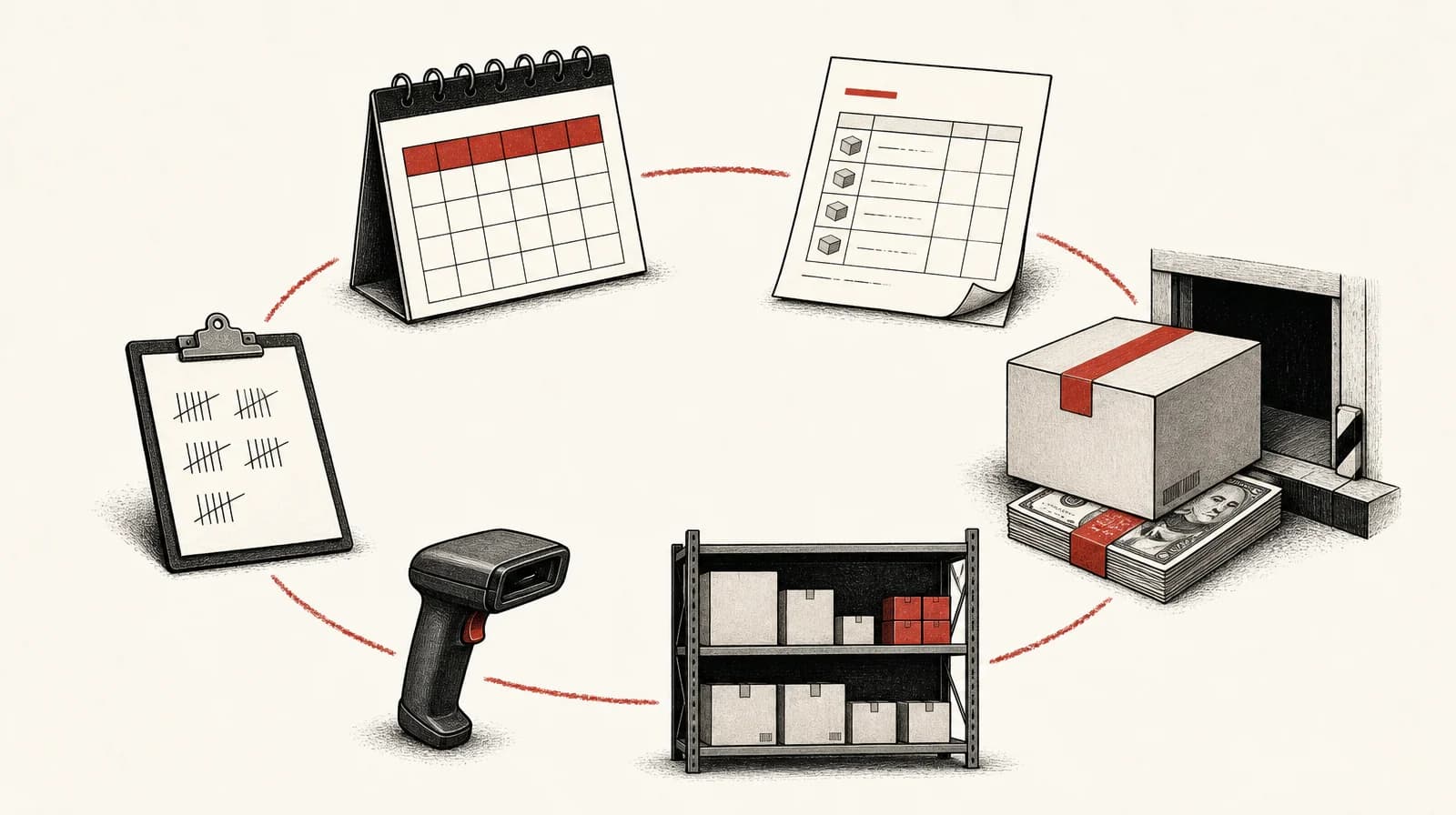
Run forecast, purchase, receive, store and fulfil, track, then count.
Treat the owner split, the weekly cover check and the monthly count as a small-team recommendation.
In Shopify, On hand is Committed plus Unavailable plus Available.
Stop the next purchase if the shelf count disagrees.
For a D2C brand that buys finished goods, this guide uses six steps: forecast, purchase, receive, store and fulfil, track, then count and reconcile. Cover weeks are the sales period you choose to buy for.
Six steps, and who should own each one
The owners, the weekly cover check and the monthly count are a recommendation for a small team.
The person who already owns the buying calendar sets the forecast. They need recent fulfilled sales, promotions already committed, and the supplier lead time they are using. The output is a unit need before the next receipt you can count on. Revisit it when you check cover, and reset it when a count changes the quantity you thought you started with.
The person who can commit cash places the purchase, and can buy less than the forecast. They need the forecast, the cash they are willing to tie up, and quantities already in Incoming. The output is a purchase order with quantities. Do not raise that order if the physical count and the system states disagree.
When a shipment arrives, Keel's inventory guide has the team verify the contents against the purchase order, inspect quality, log the items, and allocate them to storage locations. On Shopify, Incoming units are not at the location and are not available to sell. The person, or a third-party logistics provider (3PL), who opens the carton checks it against the purchase order. You still decide whether to accept that count into the system. Record shorts, damages and extras before anyone sells against the receipt.
The location that fulfils the variant stores the accepted units and ships the orders. When variants are included in an order, Shopify reduces Available and increases Committed. After the order is fulfilled, Shopify reduces Committed. Unavailable units remain inside On hand, and they are not units you can sell. Available is not shown for a location that does not fulfil the variant. If On hand is recorded and Available is a dash, the variant is inactive at that location. Do not treat that dash as a stockout.
Each week, the person who places purchases compares Available and Incoming with the cover assumption and writes the gap.
Count the shelf on its own schedule. Sumtracker advises a one-time full physical count, then rolling cycle counts. The interval here is a monthly count of the variants you are about to reorder, and a full count when you first stop trusting the file. Adjust the system only after you know why the units differ. If a 3PL sends the audit, name who on your side reads the variance.
Published lists do not match
Keel's UK guide lists five stages: demand forecasting, purchasing, storage, order fulfilment and tracking. Yellowhead Storage lists purchasing, production, holding, sales and reporting.
Drop production if you buy finished goods
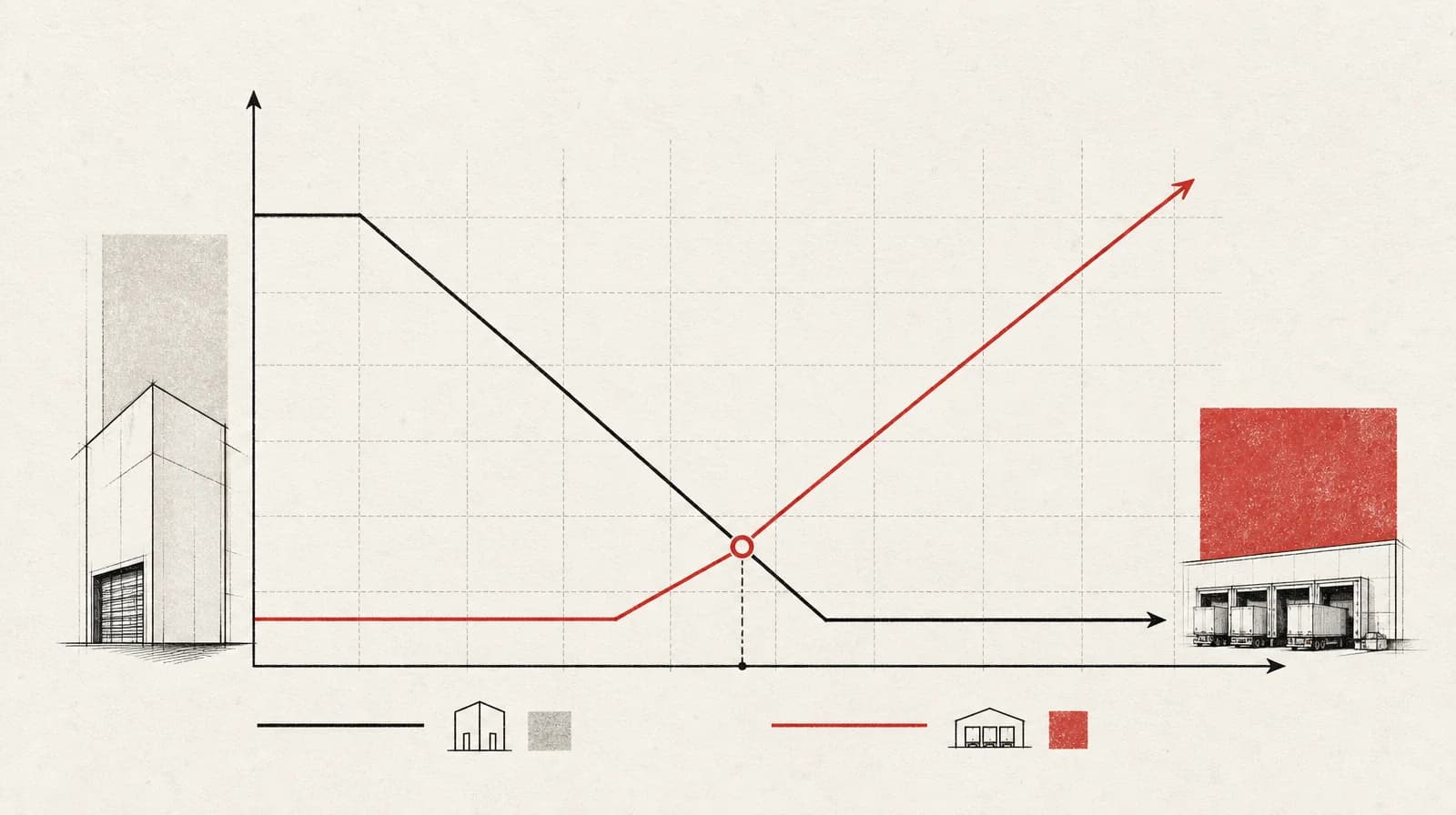
Production belongs in a list for a business that makes what it sells. Yellowhead places it between purchasing and holding. If you buy finished goods, you do not run that stage. Where the goods sit is separate from the quantity you fund.
Separate the forecast, the cash and the holder
The forecast is the sales you expect over the cover period you chose. The purchase is the quantity you will fund. Say the forecast is 400 units. The purchase can still be 200 if the cash is already in stock, or in a campaign you will not cut.
Who holds the stock is a third decision: your location, a 3PL, or a split. Demand planning vs supply planning is the page for the forecast against the supply plan. 3PL, owned fulfilment or hybrid is the page for who holds the goods. This loop assumes that choice is already made, and that someone on your side still owns the numbers the holder reports.
Where receive, commit and fulfil land in Shopify
These labels are Shopify's, for merchants using Shopify. Other platforms use different names.
Shopify's Help Center describes an inventory state by whether units are on hand and available to purchase, committed, unavailable, or part of an incoming shipment. On hand is the total of Committed, Unavailable and Available. Available is the part of On hand you can sell. Incoming is outside that total, and it is the only state for quantities not physically present at a location. Units are not available to sell while they remain Incoming.
An order commits stock: Available down, Committed up. Fulfilment releases the commitment: Committed down. Shopify's documentation on inventory quantities and states says the GraphQL Admin API cannot adjust or move quantities in the committed state. Shopify manages that state by creating and fulfilling orders, reserving inventory on draft orders, and marking transfers or shipments as ready to ship. Stock reserved on a draft order is Committed, so it is not still available to sell.
Weekly cover, monthly count
Check cover once a week, before a purchase order goes out, on the variants you might reorder. Use your own cover-week assumption. Read Available, add Incoming, and compare that with expected sales over the cover period. On hand is the wrong starting number, because Committed and Unavailable are already inside it, and Incoming is not. Sumtracker says to check available inventory as well as on hand, and to check incoming so you do not order stock already on the way.
The monthly count is the shelf count in the step above. Another export of the same file will not show a missing carton.
An invented reorder
The figures in this section are made up so the arithmetic can be checked. They are not a result from a brand, and they do not say what you should hold.
Assume you want six weeks of cover on one finished good, and you expect to sell 40 units a week. Six times 40 is 240. That cover target is the assumption, not a finding.
The system shows On hand of 200. That 200 is Committed 50, Unavailable 30, and Available 120. The identity holds: 50 plus 30 plus 120 is 200. Incoming is 90. It is not at the location, so it is not inside the 200 and it is not inside the 120.
Three purchase quantities follow.
If you subtract On hand from the target, 240 minus 200 is 40. That treats Committed and Unavailable units as if you could still sell them, and it ignores the 90 already on the way.
If you subtract Available only, 240 minus 120 is 120. That respects what you can sell today, and it orders the 90 again.
If you subtract Available plus Incoming, 240 minus 210 is 30. That is the purchase the identity supports, if the shelf agrees with the system.
Stop when the shelf and the system disagree
In this invented case, the shelf does not agree. The count is 150 units at the location, not 200. Stop the purchase. Do not place the order for 30, and do not swap 150 into the formula until you know why the units differ. A short count can be units discarded or shipped without a matching adjustment, orders the picker cannot find, or a receipt logged before the carton arrived. Incoming of 90 does not explain a hole in stock that is supposed to be at the location already.
Place the next purchase only after the count and the states describe the same goods.
Sources
- Understanding inventory states help.shopify.com An inventory state defines the status of a product, including whether it is on hand and available to purchase, committed, unavailable, or part of an incoming shipment.
- Manage inventory quantities and states shopify.dev Shopify's own developer documentation says the GraphQL Admin API cannot adjust or move quantities in the Committed state. This is official API behaviour, not just a secondary reading by Autonomous Tech.
- 5 Stages of the Inventory Management Process: Steps and Process Flow (UK Guide) keel.so The Key Takeaways on the current Keel page list five stages: demand forecasting, purchasing, storage, order fulfilment and tracking.
- What Is Inventory Management? Meaning & Methods keel.so When shipments arrive, teams verify contents against purchase orders, conduct quality inspections, log items into the inventory system, and allocate goods to storage locations. Vendor practice guidance, not a standard.
- 5 Key Stages of the Inventory Management Process logiwa.com Stages listed: planning and forecasting, ordering and stocking, tracking and monitoring, replenishment and fulfilment, and auditing and reporting.
- Inventory Management Process ordoro.com Stage list retrieved: planning from forecasts and business goals, acquisition, storage, sales, and review and optimisation. No distinct receiving or counting stage in the list seen.
- What are the 5 stages of the inventory management process? yellowheadstorage.ca The five stages given are purchasing, production, holding, sales, and reporting.
- Shopify inventory sync problems autonomoustech.ca Secondary interpretation: Shopify's available quantity excludes committed and unavailable units, so it is not a warehouse on-hand count.
- Shopify Inventory Management: A Complete 2026 Guide sumtracker.com Vendor advice: when deciding whether to reorder, look at available inventory rather than only on hand, and check incoming so you do not order stock already on the way.
- How does inventory management work in the beverage industry? hillebrandgori.com Beverage-import framing only, not a measured effect: money tied up in inventory cannot be spent on other things, for example marketing campaigns.
- Shopify Available vs On Hand prediko.io Disagrees with the Shopify Help Center identity: describes four states and says available is on hand minus committed.