Key takeaways
Owned fulfilment commits you to space and staff; a 3PL shifts more of the bill toward activity.
Compare full costs at your own order volume, then test how storage, minimum charges and contract terms affect cash in a slow month.
Choosing between a 3PL, your own warehouse and a hybrid setup starts with how much fixed cost your order volume can carry. Compare the bill in a slow month as well as the cost per order when sales are strong.
Lease space and hire ahead of demand, and you carry fixed costs while the orders catch up. Staying with a 3PL can also cost more if your own operation would be cheaper at the same service level. Switching takes planning: check your provider's exit terms, and allow for the time needed to open a warehouse. FCBCO estimates 6 to 12 months from lease signing for a move into an existing facility.
What distribution management actually decides
Distribution management is the coordination of getting finished goods from a manufacturer or supplier to the end customer: warehousing, inventory positioning, picking and packing, and last-mile delivery.
The decision is which entity performs those functions: a third-party logistics provider (3PL), your own warehouse and staff, or a split between the two. Each option commits you to a different mix of fixed and variable costs.
How fixed costs change the calculation
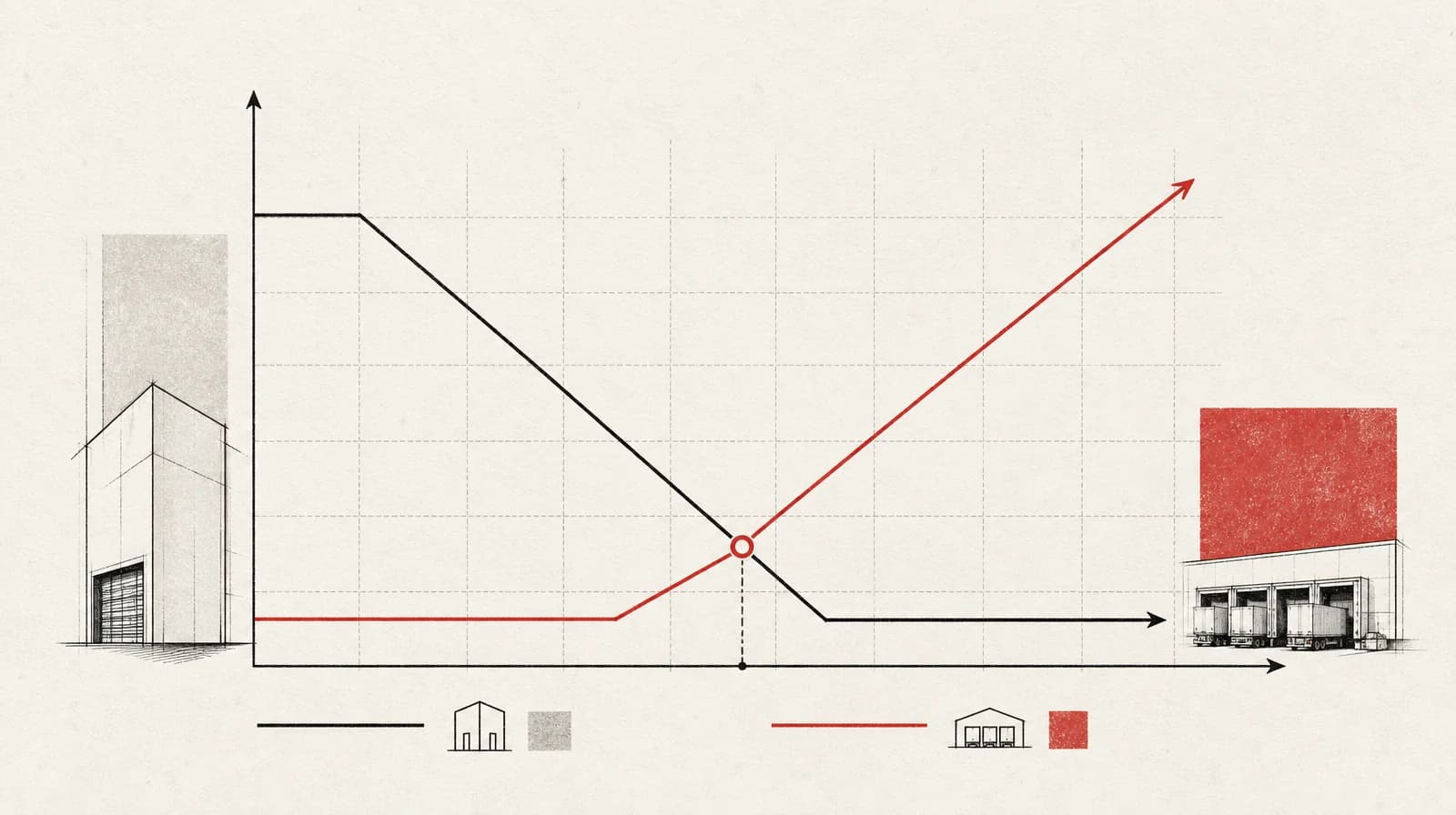
Start with how each model charges for capacity. ELM Logistics' cost-to-serve analysis describes owned fulfilment as having higher fixed costs and a lower marginal cost per order than a 3PL. Rent, software and permanent staff can stay much the same while orders rise within the capacity you already have. A 3PL shifts more of the bill towards activity, including pick-and-pack charges, although storage fees and monthly minimums still need paying.
If your costs follow that pattern, the two lines cross at a break-even volume. Below it, the 3PL costs less. Above it, spreading your fixed costs across more orders can make owned fulfilment cheaper. A need for more space, another shift or new equipment changes the calculation.
Read the assumptions behind break-even estimates
The published estimates use different assumptions. Atomix Logistics puts cost parity at roughly 100 to 300 monthly orders, depending on package size and weight, returns, customer locations and warehouse expenses. It also gives an example at about 50 orders a month where in-house may cost less if you have space available and avoid substantial new fixed costs.
Digital Applied says in-house is typically cheaper below 500 monthly orders and a 3PL becomes cheaper above 1,000 for most SKU profiles. Its explanation includes shared warehouse costs and carrier discounts, and its comparison lists costs for both models. Digital Applied is a digital marketing business publishing a fulfilment guide.
Lite Fulfillment cites a break-even band of 1,500 to 2,500 monthly orders among the brands it has onboarded. The same page says the gap narrows above 5,000 orders and a well-run in-house operation may match or beat a 3PL at 8,000 to 15,000. Those are distinct claims. Quoting its first band as a threshold for bringing fulfilment back in-house would misread its advice.
Atomix and Lite are 3PLs describing the economics of services they sell.
Build your own comparison: the two cost stacks
ELM Logistics recommends comparing total cost to serve, including fixed, variable, overhead, inventory and risk costs on both sides. Include the costs you absorb internally as well as those a provider invoices before comparing the two totals.
For in-house fulfilment, Lite Fulfillment's cost list includes warehouse lease plus triple-net charges, payroll tax and workers' comp on top of wages, racking and conveyor equipment or its lease, a warehouse management system, packaging, and losses from shrinkage and mis-ships. Lite puts those losses at 1 to 3% of inventory value a year. Thrive 3PL's worked example at 2,500 orders a month priced in-house at roughly $9.01 per order and a 3PL at an effective $4.02 to $5.50, including an assumed carrier-rate advantage.
The 3PL side needs the same discipline. Fulfill.com's US pricing guide combines The Fulfillment Advisor's 2025 survey of more than 600 warehouses with rate cards checked in June 2026 and its own brand demand data. Its $2 to $3 B2C pick-and-pack range is a synthesis; the survey average alone is $3.20 per order. The guide also reports pallet storage at $18 to $25 a month and an average monthly minimum of about $517, before shipping.
For the UK, Eightx's 2026 cost index gives pick-and-pack at £0.45 to £2.20 per order, falling towards the lower end above roughly 10,000 orders a month. It puts mid-market B2C pallet storage at £3 to £5 a week, and all-in cost before shipping at £2 to £6 per order.
For historical context, Eightx estimates that the April 2025 National Living Wage increase to £12.21 an hour, up 6.7%, added 2 to 4% to per-order fulfilment cost. That estimate describes the 2025 increase; it is not a current wage quote.
Where hybrid actually helps, and where the claims overreach
Digital Applied describes a hybrid model that keeps fast-moving SKUs in-house and routes slow-movers or overflow to a 3PL. A separate choice is whether to divide inventory across several fulfilment locations. That can shorten delivery distances.
ShipBob's worked example adds two warehouses to a single Californian distribution point. The average shipping zone falls from 6.38 to 3.58, while its stated average fulfilment or shipping cost falls from $8.43 to $8.13 per order, about 3.6%. ShipBob does not itemise that cost measure, so the example leaves storage costs and other inclusions unclear.
For your comparison, calculate shipping, handling and storage at every location using the same order mix. Add the cost of moving stock between sites where your plan requires it.
The part the fee comparisons miss: cash timing
The comparisons above estimate what each order costs to fulfil. You also need to know how much cash is tied up in stock and when the bills fall due.
In Eightx's analysis of D2C brands that collect at checkout, days sales outstanding, the wait to collect a sale, is near zero. Days payable outstanding is the time you have to pay suppliers. That leaves days inventory outstanding, how long stock sits before it sells, as the dominant lever in your cash conversion cycle: Eightx's 2026 cash-conversion-cycle benchmark across public D2C verticals puts days inventory outstanding at roughly 80% of the spread between verticals. At a 60-day cash conversion cycle, Eightx estimates a brand ties up roughly $164,000 per $1 million of annual cost of goods sold, a US dollar figure; convert at your own rate and treat it as an order-of-magnitude illustration, not a precise UK figure. At 120 days that doubles, and the shortfall has to come from equity, debt or slower growth.
The sources used here do not model the direct effect of choosing 3PL versus owned fulfilment on that cash cycle. What can be said, as reasoning rather than a borrowed statistic: a 3PL's variable, pay-per-order charges fall when you ship fewer orders. Storage fees and monthly minimums may still be due, so compare the full bill for a slow month with the rent and payroll you would carry in-house. That's an argument about volatility and downside protection, not a claim that either model shortens or lengthens your cash conversion cycle on average.
What locks you in, either way
Include the cost and timing of a move in your comparison. The cheaper ongoing option may need cash and preparation before you can use it.
For a move away from a 3PL, Warematch's transition guide describes notice periods of 30 to 90 days and possible minimum commitments or early exit fees. It also flags inventory-release requirements, such as how stock must be packed or palletised. Check your own agreement for each of these terms and plan the move around its actual termination date.
Moving toward owned fulfilment: FCBCO estimates 6 to 12 months from lease signing to move into an existing warehouse. That estimate covers an existing facility; it does not describe a new building project. Check the site work, systems and staffing schedule before committing to a launch date.
Once you have a realistic transition date, work through the commercial decision before signing a lease or a 3PL agreement.
- Price the in-house cost stack: lease, labour on-costs, equipment, software, packaging and shrinkage.
- Get a comparable 3PL quote in your own currency and market (US or UK figures don't transfer) and check what it excludes: setup fees, storage, minimums, surcharges.
- Plot the cost crossover.
- Check your current or prospective 3PL contract for notice period, minimum commitment and exit fees before you assume switching is free.
- Model days inventory outstanding and supplier payment terms alongside fulfilment costs.
What this doesn't settle
Your catalogue's returns, handling requirements and seasonal peaks still need pricing. For a UK warehouse, that also means local quotes for space, equipment and staff.
Contribution profit, revenue after product cost, discounts, shipping, payment fees and expected returns, is what's left to pay for warehousing in the first place. Know your own number before you compare fulfilment quotes against anyone else's.
Sources
- Distribution Management Defined: Channels, Benefits, & Solutions shipbob.com Defines distribution management as overseeing movement of finished goods to end user, listing warehousing, pick-pack and last-mile as constituent activities.
- Distribution Management: Definition, Benefits and Challenges anchanto.com Defines distribution management as an umbrella term covering packaging, inventory, warehousing and logistics, then pivots to OMS/WMS software capability rather than operating-model choice.
- Distribution Management: Definition, Process & Strategy qoblex.com Distinguishes distribution management (finished goods to customer) from supply chain management (sourcing through delivery); distribution management is a component of the broader framework.
- In-House Fulfillment vs. 3PL: The True Cost elmlogistics.com Owned fulfilment is high fixed cost with lower marginal cost per order; 3PL is lower fixed cost with higher marginal cost per order; crossover point is the economic break-even.
- 3PL vs In-House Fulfillment litefulfillment.com Itemises in-house cost stack: lease and triple-net charges, payroll tax/workers comp/PTO, equipment, WMS software, retail-rate packaging, and shrinkage/mis-ships at 1-3% of inventory value annually.
- eCommerce Fulfillment: 3PL vs In-House Guide 2026 digitalapplied.com Describes hybrid model: high-velocity SKUs in-house, slow-movers and overflow to 3PL, reducing both fixed costs and 3PL fees.
- In-House vs 3PL Fulfillment atomixlogistics.com Puts cost parity at roughly 100-300 monthly orders depending on product size, weight and returns complexity.
- 3PL vs In-House Fulfillment: A Real Cost Analysis thrive3pl.com Thrive's worked example at 2,500 orders/month gives in-house about $9.01/order versus 3PL about $4.02-$5.50/order. The page supplies component costs and assumptions, including a carrier-rate saving in the effective 3PL cost. This is one provider's model, not an independently measured market average.
- How Much Does a 3PL Cost in 2026? 16 Fee Benchmarks fulfill.com Fulfill's 2026 guide combines The Fulfillment Advisor's 2025 survey of more than 600 warehouses, published rate cards verified in June 2026, its own rate-card analysis and separate brand demand data. Its $2-$3 B2C pick-and-pack range is the guide's synthesis, not the 2025 survey result alone.
- UK 3PL & Fulfilment Cost Index 2026 eightx.co Eightx's 2026 UK cost index gives pick-and-pack £0.45-£2.20/order, falling towards the lower end above roughly 10,000 orders/month. Mid-market B2C pallet storage is £3-£5/week and all-in cost before shipping £2-£6/order. Attribute these as the publisher's benchmarks.
- Cash Conversion Cycle by Vertical: 2026 Benchmarks eightx.co Page is a 2026 cash-conversion-cycle benchmark across public DTC verticals (range given as 26 days for CPG to 194 days for distressed beauty), not a standalone public-filings study; attribute the figure to this vertical benchmark.
- How Do I Switch to a New 3PL Provider without Disrupting My Business? warematch.com Warematch supports only the exit mechanics: a termination clause with a notice period typically 30 to 90 days, possibly a minimum commitment or early exit fee, plus inventory release terms (how stock must be packaged/palletised) and data export rights.
- How to Improve Space Utilization in Your Fulfillment Center fcbco.com FCBCO estimates 6-12 months after signing a lease for a move into existing warehouse premises. Keep that project scope and starting point; do not describe this estimate as construction from scratch or a guaranteed minimum.
- What is Distributed Inventory? 3 Benefits of Using Multiple Fulfillment Centers shipbob.com The vendor's example changes average shipping zone from 6.38 to 3.58 and average fulfilment or shipping cost from $8.43 to $8.13 per order. The latter is a calculated saving of about 3.6%. Costs included are not itemised; storage inclusion and a broader denominator than parcel spending cannot be inferred.


